Introduction
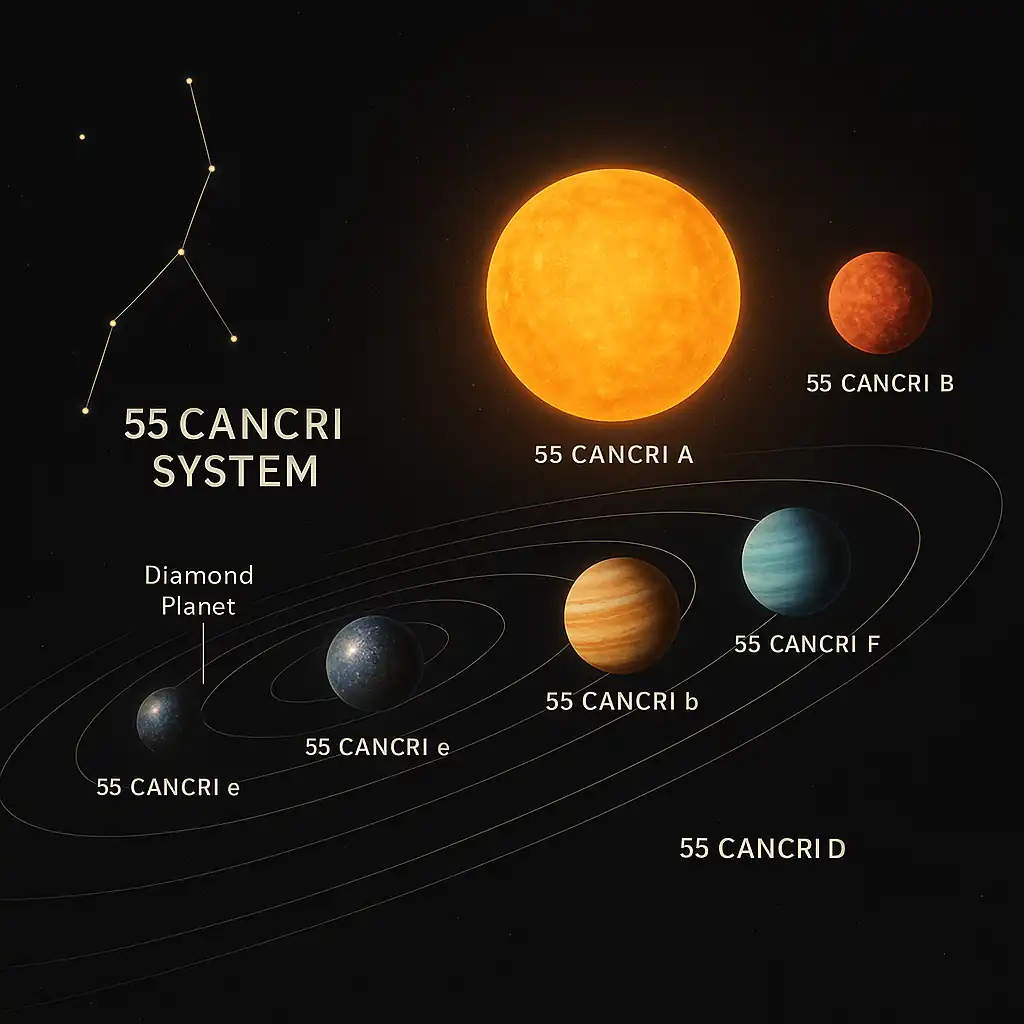
The 55 Cancri e diamond planet captures the imagination of astronomers and enthusiasts alike. Located 40 light-years away in the Cancer constellation, this super-Earth orbits its star, 55 Cancri A, a sun-like star visible to the naked eye. Discovered in 2004, it stands out due to its unique composition, potentially rich in carbon that may form diamond layers. Its proximity to its star—25 times closer than Mercury to the Sun—results in a year lasting just 18 hours. This article explores its discovery, composition theories, and estimated value of its diamond content.
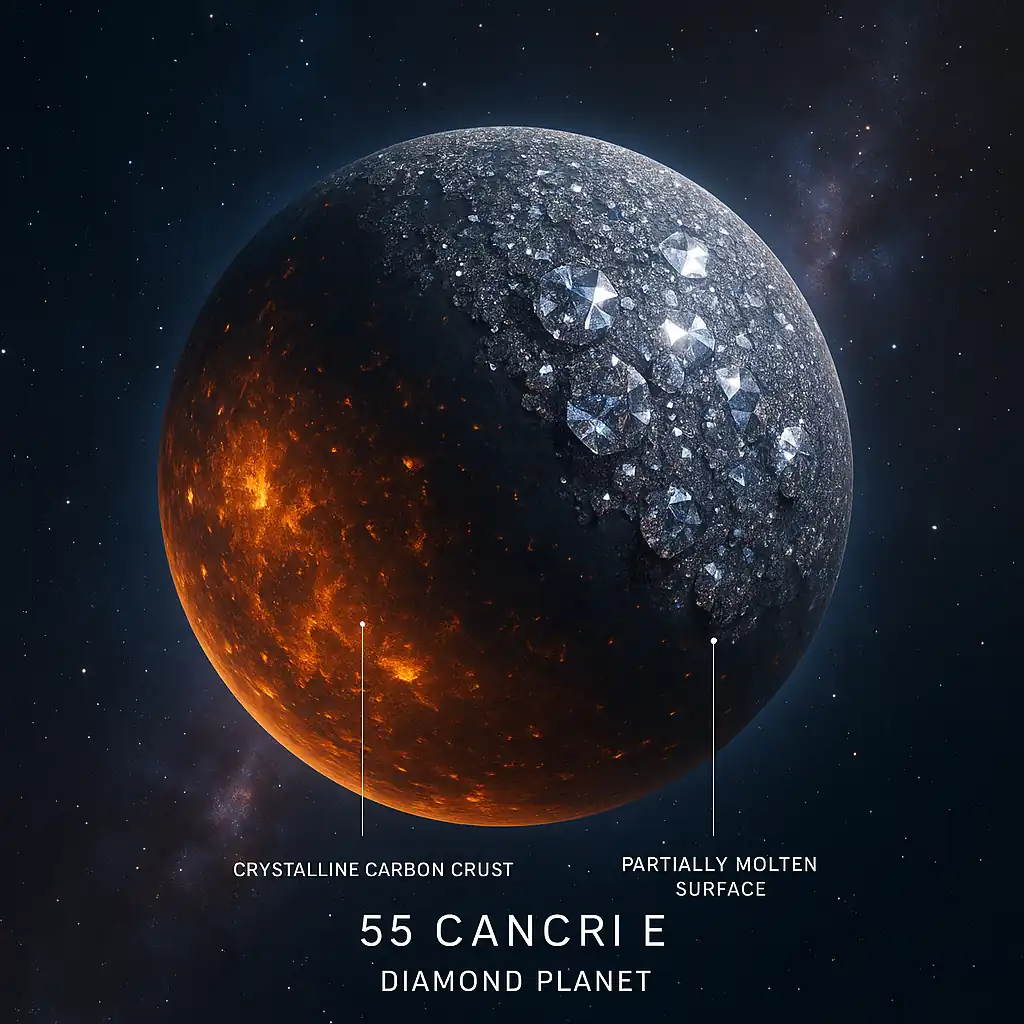
Astronomers initially dubbed 55 Cancri e a diamond planet due to early theories about its carbon-rich makeup. With a mass eight times that of Earth and a radius twice as large, it classifies as a super-Earth, bridging the gap between Earth and Neptune. Its surface temperatures soar to 3,900 degrees Fahrenheit (2,150 degrees Celsius), creating conditions ripe for diamond formation. Moreover, its tidally locked nature means one side faces perpetual day while the other endures constant night. This extreme environment makes it a fascinating subject for study.
Despite its allure, studying this planet poses challenges. Its distance and harsh conditions prevent direct exploration, relying instead on advanced telescopes like Spitzer and JWST. The evolving theories about its composition—from water-rich to diamond-rich—reflect the complexity of exoplanet research. Early assumptions have been questioned, driving scientists to refine their models. This journey into the 55 Cancri e diamond planet reveals the wonders of cosmic diversity.
Discovery and Characteristics
Astronomers discovered the 55 Cancri e diamond planet in 2004 by analyzing the radial velocity of its host star, 55 Cancri A. They detected a 2.8-day signal, later corrected to 0.7365 days (18 hours) in 2010 by Dawson and Fabrycky, confirming its ultra-short orbit. The planet transits its star, allowing precise measurements of its radius and orbit via the MOST space telescope in 2011. This transit data confirmed its super-Earth status, with a mass of 7.99 Earths. The planet orbits at 0.01544 AU, making it one of the closest known exoplanets to its star.
The 55 Cancri e diamond planet exhibits extreme characteristics due to its proximity to its star. Its surface temperature averages 2,700 K (2,430°C) on the dayside and 1,380 K (1,110°C) on the nightside, hot enough to melt iron. It is tidally locked, with one side in perpetual daylight and the other in darkness, creating stark temperature contrasts. Additionally, its orbital inclination of 83.6° suggests alignment with its star’s rotation, hinting at a gentle inward migration. These traits set it apart from Earth-like planets.
In contrast, the planet’s discovery sparked debates about its true nature. Early analyses suggested a longer orbital period of 260 days, but further studies confirmed the 18-hour orbit. Its high density initially puzzled researchers, leading to theories about its composition. The 55 Cancri e super-Earth remains a key subject for understanding planetary formation in carbon-rich systems. This section sets the stage for exploring its diamond composition theory.
Diamond Composition Theory
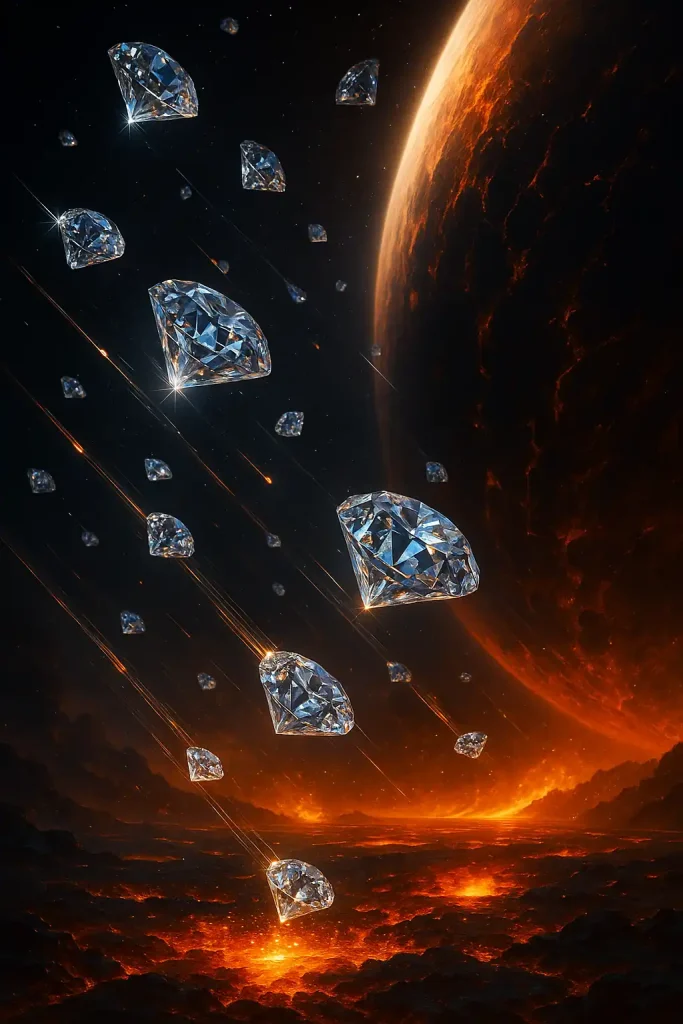
The 55 Cancri e diamond planet earned its nickname from early theories about its carbon-rich composition. In 2012, Yale researchers, led by Nikku Madhusudhan, proposed that up to a third of its mass—equivalent to three Earth masses—could be carbon, much of it as diamond and graphite. The planet’s host star, 55 Cancri A, shows a high carbon-to-oxygen ratio, suggesting the planetary system formed from carbon-rich material. High pressures and temperatures inside the planet could transform this carbon into diamond, creating a unique rocky world.
Initial models suggested the planet’s interior includes an iron core, a silicon carbide mantle, and a graphite-diamond crust. Unlike Earth, which is oxygen-rich with minimal carbon, this planet’s chemistry is fundamentally different, lacking water and silicates. Researchers used the planet’s mass, radius, and stellar composition to build these models, estimating its internal structure. However, a 2013 study by Johanna Teske at the University of Arizona found the star’s carbon-to-oxygen ratio lower than previously thought, casting doubt on the diamond-heavy theory. This debate highlights the complexity of exoplanet analysis.
Despite this, the diamond planet theory persists as a possibility. The extreme conditions—3,900°F surface temperatures and immense internal pressures—support the idea of diamond formation. Carbon under such conditions naturally crystallizes into diamond, unlike Earth’s silicate-dominated crust. Scientists continue to refine their models, using data from Spitzer and other telescopes. The 55 Cancri e diamond planet remains a symbol of cosmic diversity, pushing the boundaries of planetary science.
Estimated Value of Diamonds
The 55 Cancri e diamond planet has been valued based on its potential diamond content, though estimates are speculative. In 2012, Forbes estimated its worth at $26.9 nonillion ($26.9 followed by 30 zeros), assuming a third of its mass is diamond. The planet’s mass is 7.99 Earth masses, or roughly 51,521,100,000,000,000,000,000,000 kg. If a third is diamond, that’s about 17,173,700,000,000,000,000,000,000 kg of diamond. At $1,113,500 per kg (based on 2012 diamond prices of $222.7 per carat), the total value reaches approximately $19.1 nonillion.
However, this diamond planet value hinges on Earth’s market dynamics, which don’t apply in space. Diamonds on Earth are priced high due to controlled supply by companies like De Beers, despite their relative abundance. If 55 Cancri e’s diamonds were accessible, their sheer volume would crash the market, rendering them nearly worthless. Moreover, the planet’s inaccessibility—40 light-years away—and extreme conditions make mining impossible. This estimate, while intriguing, serves more as a thought experiment than a practical valuation.
Interestingly, diamond prices have fluctuated since 2012. Some sources note that by 2022, the price per carat dropped, potentially doubling the $26.9 nonillion estimate to $53.8 nonillion, though this remains speculative. The value underscores the planet’s theoretical richness but also highlights economic realities. Even if reachable, the influx of diamonds would disrupt Earth’s economy. The 55 Cancri e diamond planet thus remains a cosmic curiosity rather than a tangible asset.

Atmosphere and Conditions
The 55 Cancri e diamond planet features extreme conditions due to its proximity to its star. Its dayside temperature reaches 2,700 K (2,430°C), while the nightside averages 1,380 K (1,110°C), as measured by the Spitzer Space Telescope. This stark contrast arises from its tidally locked state, with one side facing constant stellar radiation. The planet receives more radiation than Gliese 436 b, another hot super-Earth, making it uninhabitable. Such heat suggests a molten surface, possibly with lava oceans reflecting silicate clouds.
Recent studies reveal a complex atmosphere on this planet. Early theories proposed a hydrogen-helium envelope, but 2024 JWST observations suggest an atmosphere rich in carbon dioxide or carbon monoxide, ruling out a rock vapor scenario. The atmosphere likely stems from a bubbling magma ocean, redistributing heat from the dayside to the nightside. CHEOPS and JWST data show a cooler dayside than expected, indicating atmospheric heat distribution. These findings challenge earlier models of heat transfer solely by lava flows.
Nevertheless, the planet’s conditions remain hostile. The high temperatures and radiation make life as we know it impossible. Its molten surface and potential volcanic activity further complicate its environment. Some theories suggest supercritical fluids—liquid-like gases—may seep from its rocks, adding to its alien nature. The 55 Cancri e diamond planet continues to intrigue scientists, offering insights into the diversity of exoplanetary atmospheres and conditions.
Leave a Reply