Introduction
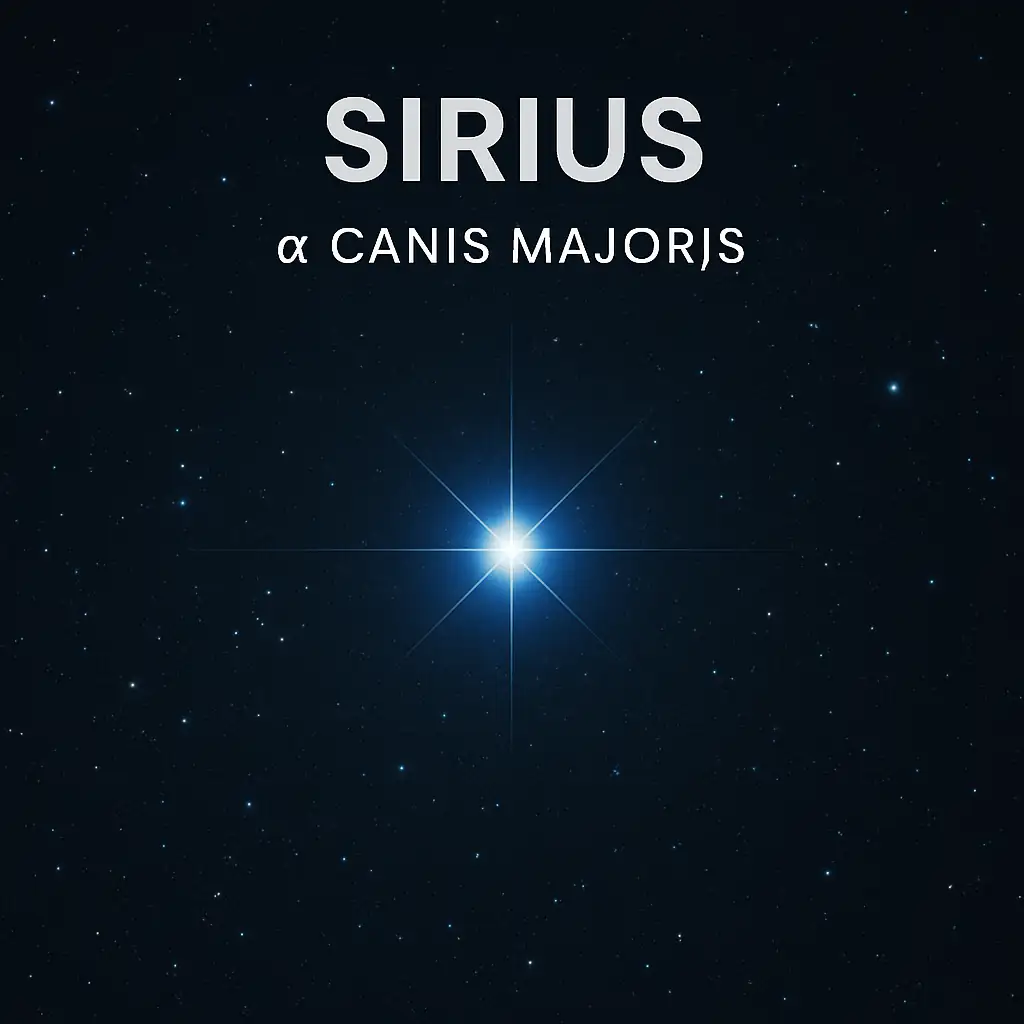
Sirius brightest star captivates skywatchers as the most luminous star visible from Earth. Known as the “Dog Star,” Sirius resides in the Canis Major constellation, earning its nickname from its role as the “greater dog” of Orion the Hunter. With an apparent magnitude of -1.46, it outshines all other stars in the night sky, appearing 25 times brighter than the next brightest star, Canopus. Located just 8.6 light-years away, its proximity and intrinsic brightness make it a celestial marvel. This article explores Sirius’s history, characteristics, and why it dazzles so brilliantly.
Ancient cultures revered Sirius brightest star for its striking presence. It lies close to the ecliptic, making it visible across most of the globe, except in extreme northern latitudes like parts of Alaska or northern Scandinavia. Sirius’s white-blue hue and twinkling effect, caused by Earth’s atmosphere, add to its allure. Moreover, its cultural significance spans millennia, from ancient Egypt to modern astronomy. Let us dive into its historical importance and scientific traits.
Despite its fame, observing Sirius poses challenges. Its intense brightness can overwhelm smaller telescopes, creating glare that obscures fine details. Light pollution in urban areas also dims its splendor, though it remains visible even in city skies. Astronomers use advanced tools to study its properties, revealing a complex binary system. This journey into Sirius unveils its cosmic story and enduring appeal.
Historical Significance
Ancient Egyptians celebrated Sirius, calling it Sopdet, associating its heliacal rising—when it first appears before sunrise—with the Nile’s annual flooding around 3000 BCE. They linked it to the goddess Isis, marking it as a harbinger of fertility and renewal in their calendar. Greek sailors named it Seirios, meaning “scorching,” due to its brightness during summer, believing it influenced the hot “dog days” of July and August. This belief tied Sirius in constellations to seasonal changes across cultures.
Medieval Islamic astronomers named Sirius “Al-Shi’ra al-Yamaniyya” (شِعری یَمانی), meaning “the shining one of Yemen,” reflecting its southern position in their sky. They used it for navigation and timekeeping, as its predictable rising helped mark prayer times. Modern observations, like those from the Hubble Space Telescope and the James Webb Space Telescope in 2023, confirm its binary nature, linking ancient lore to cutting-edge science. These discoveries enhance its historical role as a celestial guide.
Interestingly, some cultures attributed mystical powers to Sirius. The Dogon people of Mali claimed ancestral knowledge of its binary system, a claim debated by scholars due to lack of records, yet supported by recent spectral analyses. European folklore saw it as an omen for harvests or weather, a belief echoed in today’s astrophotography trends. The historical significance of the Sirius brightest star bridges ancient myths with modern astronomical insights.
Physical Characteristics
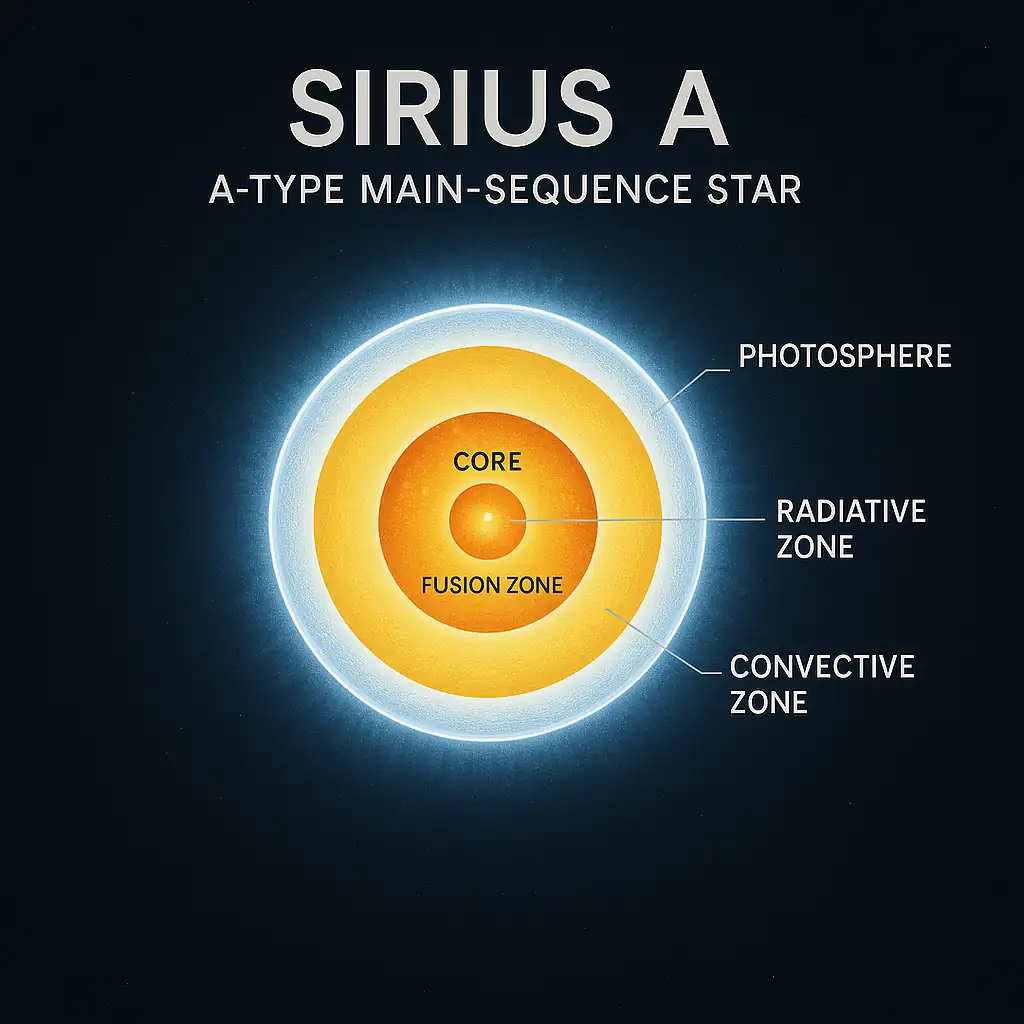
Sirius brightest star owes its radiance to its intrinsic properties and proximity to Earth. As a main-sequence star of spectral type A1V, Sirius A burns with a surface temperature of 9,940 K (9,670°C), giving it a white-blue glow. It spans 1.71 times the Sun’s diameter and shines with a luminosity 25.4 times greater, fueled by hydrogen fusion in its core. Its mass, 2.06 times that of the Sun, ensures a stable life of about 1 billion years, of which 240 million years have passed.
The Sirius brightest star benefits from being just 8.6 light-years away, the fifth-closest star system to Earth. This closeness amplifies its apparent brightness, though it is not the most luminous star intrinsically—stars like Rigel outshine it in absolute terms. Sirius A’s high surface temperature and size make it a beacon in the night sky. Additionally, its rapid rotation, with an equatorial speed of 16 km/s, slightly flattens its shape at the poles.
In contrast, Sirius’s brightness varies subtly due to atmospheric effects. Its light scatters in Earth’s atmosphere, causing it to twinkle with hues of blue, red, and white, especially when low on the horizon. This phenomenon, called scintillation, enhances its visual appeal but can hinder precise measurements. The physical traits of the Sirius brightest star make it a stunning example of stellar evolution.
Binary Star System
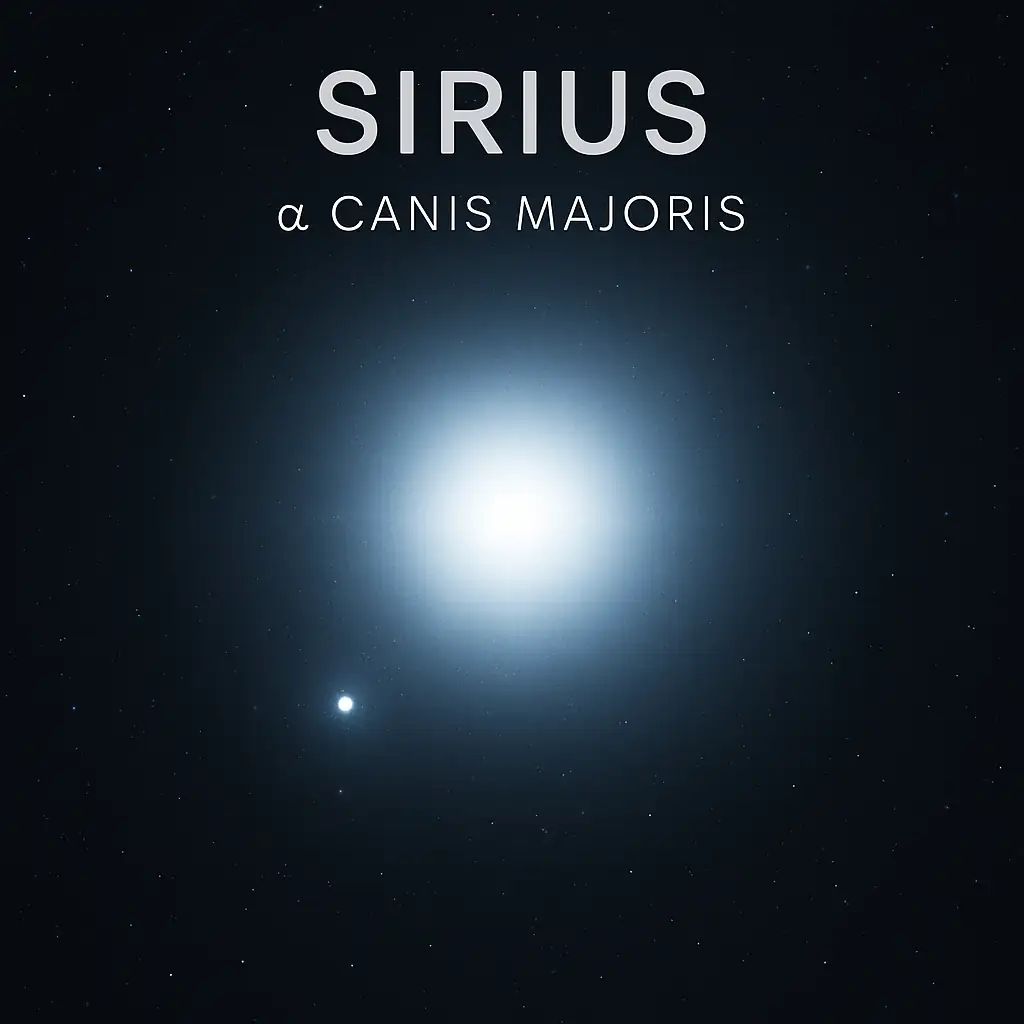
The Sirius brightest star forms part of a binary system, consisting of Sirius A and its faint companion, Sirius B. Discovered in 1862 by Alvan Graham Clark using an 18.5-inch telescope, Sirius B is a white dwarf—the remnant core of a star that has exhausted its fuel. With a magnitude of 8.44, Sirius B is 10,000 times fainter than Sirius A, making it invisible to the naked eye. The two stars orbit each other every 50.1 years at an average distance of 20 AU, roughly the distance from the Sun to Uranus.
Sirius A and B offer a unique opportunity to test Einstein’s general theory of relativity. Sirius B’s strong gravitational field, despite its small size, bends light from Sirius A during their orbit, a phenomenon observable as a slight shift in position. This gravitational lensing, first measured by the Hubble Space Telescope in 2005, aligns with relativity predictions, confirming spacetime curvature. Moreover, the system’s precise orbits allow scientists to study gravitational waves, refining our understanding of cosmic dynamics.
Despite their proximity, observing Sirius B challenges astronomers. The overwhelming glare of Sirius A often overshadows its companion, requiring advanced techniques like adaptive optics to separate them. Some theories suggest Sirius B’s past nova outbursts influenced the system’s chemistry, though evidence remains inconclusive. The binary nature of the Sirius brightest star deepens its scientific intrigue, especially for relativity studies.
Observational Details
The Sirius brightest star dazzles observers with its vivid presence in the night sky. Located at a right ascension of 06h 45m and declination of -16° 43’, it dominates the Canis Major constellation, southeast of Orion’s Belt. Its heliacal rising in late summer makes it a seasonal marker, visible from July to April in the Northern Hemisphere. Sirius peaks highest in the sky around midnight in mid-January, offering prime viewing opportunities.
Amateur astronomers can spot Sirius without equipment due to its -1.46 magnitude, but binoculars reveal its twinkling colors. Telescopes with at least an 8-inch aperture can resolve Sirius B under ideal conditions, though atmospheric turbulence often interferes. The star’s low position on the horizon amplifies scintillation, making it flicker dramatically. Modern observatories, like the Hubble Space Telescope, have captured detailed images of the Sirius A and B system, refining our understanding.
Nevertheless, urban light pollution dims Sirius’s brilliance. Viewing from rural areas or using filters improves clarity, especially for astrophotography. Some recommend observing during twilight to reduce glare. On the other hand, its visibility across latitudes—up to 73°N—ensures global accessibility. The Sirius brightest star remains a favorite for both casual stargazers and professional astronomers.
Leave a Reply