Introduction
Television, a global entertainment pillar, connects billions through news, dramas, and sports. From early black-and-white sets to modern ultra-high-definition screens, it has reshaped communication. In particular, television technology impact influences culture and daily routines. This article explores its history, technology, production, and social effects to reveal its significance. Its evolution showcases human creativity and innovation. Thus, understanding television’s role helps us navigate its benefits and challenges.
Furthermore, television prompts questions about its societal and environmental footprint. It offers endless content but demands resources in production and use. As a result, television technology impact intrigues researchers and viewers alike. By delving into its development, manufacturing, and cultural influence, we aim to provide a clear perspective. This journey highlights television’s transformative power. Let’s uncover its multifaceted story.

History of Television
Television’s history began in the early 20th century with experimental broadcasts. In 1927, Philo Farnsworth demonstrated the first electronic television in the United States. Specifically, his cathode-ray tube system transmitted images, marking a breakthrough. Early broadcasts were low-quality, but television technology impact grew swiftly. By the 1930s, regular programming emerged in Europe and North America. This launched a new entertainment era.
After World War II, television became a household essential. In the 1950s, Germany pioneered color broadcasts with the PAL system. Families gathered for news and entertainment, transforming social habits. Meanwhile, Japan’s 1960s innovations enhanced screen clarity. Thus, television’s history reflects rapid technological and cultural shifts. Its global spread reshaped leisure time.
In the late 20th century, cable and satellite TV expanded options. Digital broadcasting in the 1990s replaced analog signals, improving quality. Nevertheless, concerns about television technology impact, like excessive screen time, surfaced. The 2000s streaming revolution further changed viewing habits. This historical path underscores television’s lasting influence.

Technology and Innovation
Television technology has evolved dramatically over decades. Early cathode-ray tube (CRT) sets were bulky and low-resolution. In particular, modern LED and OLED displays deliver vibrant, clear images. Television technology impact is evident in 4K and 8K resolutions, enhancing viewer immersion. These advancements elevate entertainment quality. As a result, manufacturers strive for cutting-edge innovations.
Smart TVs now integrate internet connectivity for streaming and apps. South Korea’s Samsung led smart interfaces in the 2010s, transforming user experiences. Furthermore, quantum dot technology in QLED TVs improves color accuracy. These developments make televisions versatile hubs. Thus, technology drives television’s ongoing evolution. Viewers enjoy richer, interactive content.
However, rapid innovation accelerates obsolescence. Older TVs become outdated, contributing to electronic waste. For instance, LED TVs use 60% less energy than CRTs, per 2023 studies, improving efficiency. Television technology impact thus involves trade-offs. Sustainable design is a growing research priority to address these challenges.
Moreover, microLED technology promises brighter, durable displays. In 2024, prototypes showcased thinner, flexible screens. Meanwhile, augmented reality integration is explored for interactive viewing. These innovations highlight television technology impact on future entertainment. Research continues to push boundaries.
Production and Manufacturing
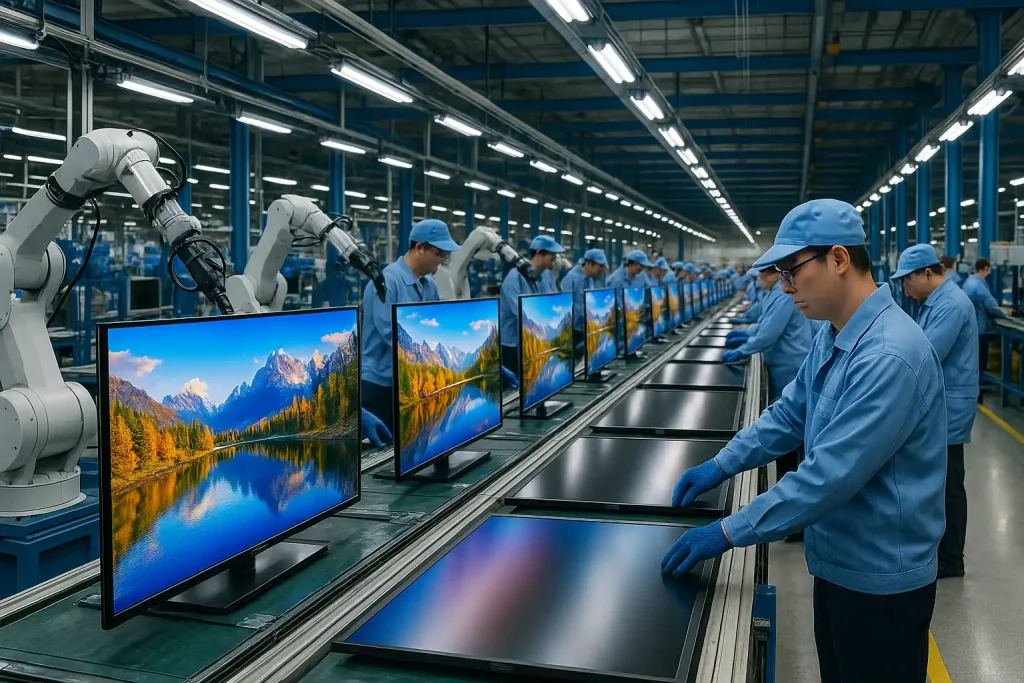
The television production process relies on global supply chains and advanced engineering. Components like screens and chips are sourced from Asia, notably South Korea and Japan. Specifically, LG and Sony use robotic assembly in high-tech factories. Television technology impact fuels demand for quality materials. This ensures reliable, affordable TVs. Thus, manufacturing supports television’s global reach.
Production involves creating panels and assembling units. Liquid crystal displays (LCDs) are made by layering glass with light-modulating crystals. In Germany, 2022 advancements cut production emissions by 10%. Furthermore, semiconductors enable smart features, requiring precise fabrication. The television production process is intricate yet efficient. It meets growing consumer demand.
Environmental concerns stem from manufacturing. Mining rare earth metals for screens damages ecosystems in Asia, per 2023 reports. Additionally, factories emit carbon due to high energy use. As a result, sustainable television manufacturing emphasizes recycling and renewable energy. Companies work to reduce their footprint. This balances production with environmental responsibility.
Labor conditions also raise ethical issues. In some regions, workers face long hours, prompting scrutiny. However, 2024 reforms in Japan improved factory standards. Television technology impact extends to social accountability. Consumers can support brands with ethical practices. Sustainable manufacturing ensures television’s future viability.

Social and Cultural Effects
Television profoundly influences society, shaping culture and behavior. It delivers news, entertainment, and education, connecting diverse audiences. In particular, television content influence drives global phenomena like reality TV, popular from the U.S. to India. Television technology impact fosters shared cultural experiences. As a result, it promotes dialogue across borders.
Nevertheless, excessive screen time poses health risks. Studies from 2023 link prolonged TV watching to obesity and mental health concerns. In Europe, campaigns encourage balanced viewing habits. Additionally, television content influence can reinforce stereotypes without diverse representation. Responsible programming is essential. Thus, television’s social impact demands careful navigation.
Television also amplifies diverse voices. Documentaries raise awareness about issues like climate change, engaging global viewers. In South Korea, dramas export cultural values, boosting tourism. Therefore, television technology impact empowers creators and informs audiences. Supporting inclusive content strengthens its positive role. This fosters a more connected society.

Leave a Reply