Introduction
Neptune, the eighth planet from the Sun, stands as a mysterious ice giant in our solar system. It resides 4.35 billion kilometers (2.7 billion miles) from the Sun, making it one of the farthest planets known. Discovered on September 23, 1846, by Johann Galle and Urbain Le Verrier, Neptune’s deep blue color captivates astronomers worldwide. For example, methane in its atmosphere absorbs red light and reflects blue wavelengths. Consequently, this gives it the nickname “Blue Giant,” reflecting its stunning appearance. Moreover, Neptune is four times larger than Earth, with a diameter of 49,244 kilometers (30,598 miles). Its mass is 17 times greater than Earth’s, ranking it among the solar system’s giants. However, the planet’s vast distance makes it challenging to study in detail. Yet, its powerful storms and faint ring system remain fascinating to researchers. As of 2025, advanced telescope technology, like the James Webb Space Telescope, has revealed more about Neptune. Thus, this article explores its formation, characteristics, atmosphere, moons, rings, and exploration history.

Formation and Characteristics of the Ice Giant
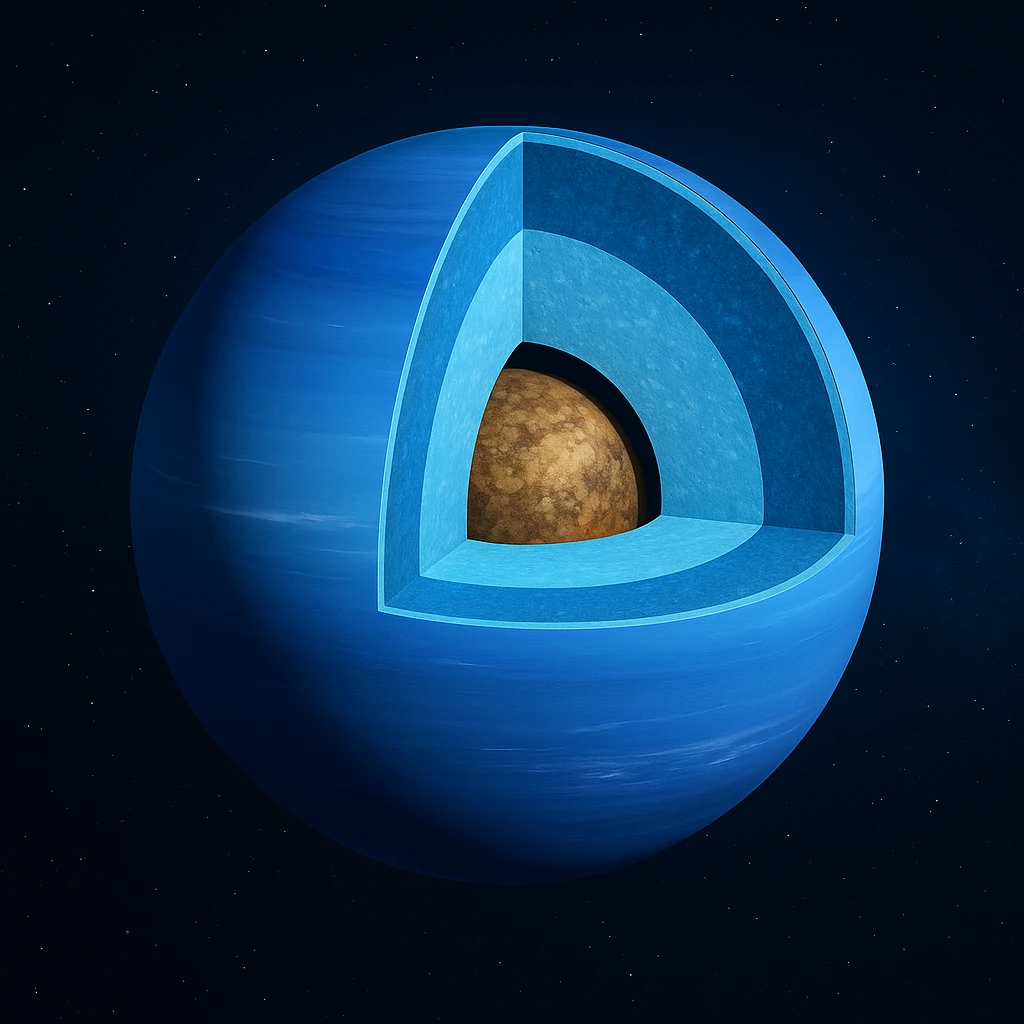
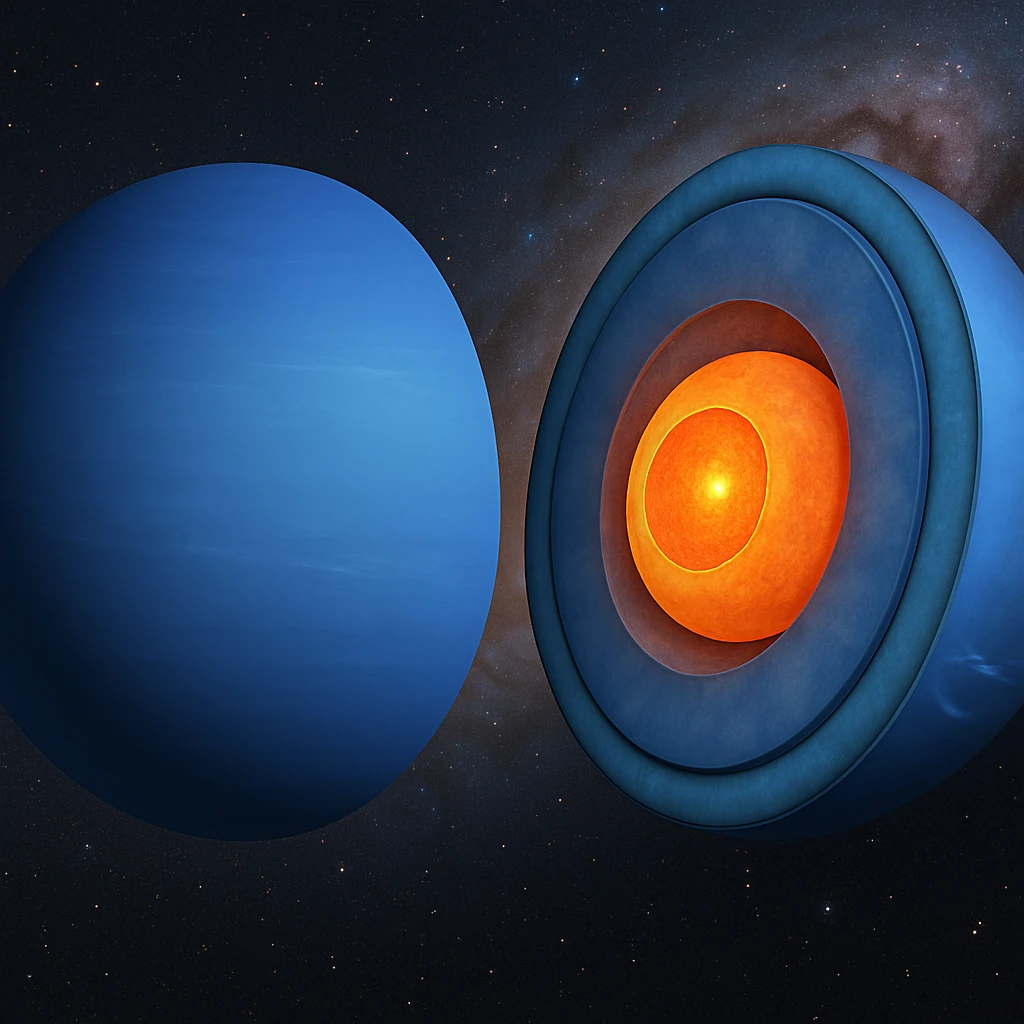
Neptune formed 4.5 billion years ago during the solar system’s early days, a time of cosmic creation. Initially, it started as a protoplanet in the cold, outer regions of the solar nebula, where ices could condense. Over millions of years, gas, ice, and rocky material came together under gravity’s pull. For instance, hydrogen, helium, and ices such as water, ammonia, and methane built its massive structure. Additionally, Neptune has a rocky core, roughly the size of Earth, estimated at 12,742 kilometers in diameter. The core, consequently, reaches temperatures of 5,000°C (9,000°F) due to intense gravitational pressure. Meanwhile, its mantle contains water, ammonia, and methane ices in a dense, fluid state. A thick gaseous atmosphere, rich in hydrogen and helium, surrounds it all. Furthermore, Neptune’s mass, 17 times Earth’s, makes it the fourth-largest planet in our solar system. It also has a strong magnetic field, tilted 47 degrees from its axis, creating unique auroras. Therefore, this makes Neptune a distinct ice giant in our cosmic neighborhood.
Atmosphere and Weather Patterns
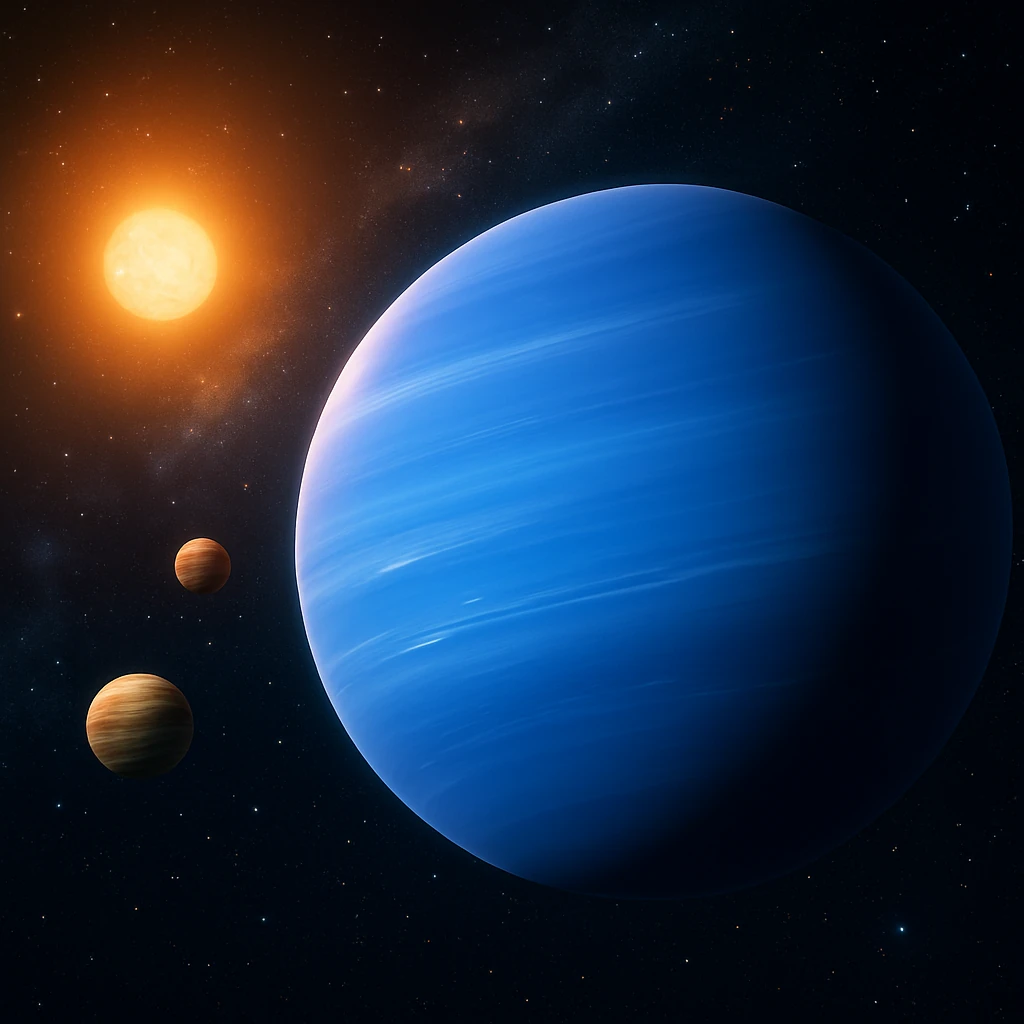
Neptune’s atmosphere is a turbulent mix of hydrogen (80%), helium (19%), and methane (1%), with traces of hydrocarbons. For example, methane causes its striking blue color by absorbing red light and reflecting blue. Moreover, winds on Neptune reach speeds of 2,400 kilometers per hour (1,500 miles per hour), the fastest in the solar system. These winds, in fact, are driven by internal heat, which exceeds the energy from the Sun. In 1989, Voyager 2 observed the Great Dark Spot, a massive storm akin to Jupiter’s Great Red Spot. However, it vanished by 1994, as Hubble later confirmed, showing Neptune’s weather changes rapidly. Additionally, smaller storms and methane ice clouds form at high altitudes. Temperatures, meanwhile, drop to -201°C (-330°F) at the cloud tops, making it one of the coldest planets. Despite this, Neptune generates significant internal heat from gravitational compression. As a result, this heat powers its extreme weather patterns, creating a dynamic atmosphere.
Moons and Rings of the Blue Giant
Neptune has 14 confirmed moons as of 2025, each with unique traits that intrigue scientists. For instance, Triton, the largest, is bigger than Pluto, with a diameter of 2,707 kilometers (1,682 miles). Discovered in 1846, Triton has a retrograde orbit, moving opposite to Neptune’s rotation. Thus, this suggests Neptune captured it from the Kuiper Belt, a region of icy bodies beyond its orbit. Additionally, Triton’s icy surface features nitrogen gas geysers, a sign of geological activity. Voyager 2, for example, imaged Triton’s “cantaloupe terrain” in 1989, showing tectonic activity. Meanwhile, other moons like Proteus, with a 420-kilometer diameter, and Nereid, with an eccentric orbit, add diversity. Neptune also has a faint ring system, discovered in 1984 through stellar occultations. The rings—Galle, Leverrier, Lassell, Arago, and Adams—are made of dust and small rocks. Moreover, the Adams ring has bright arcs shaped by the moon Galatea’s gravity. Hence, Neptune’s moons and rings form a complex, dynamic system.
Space Exploration and Discoveries
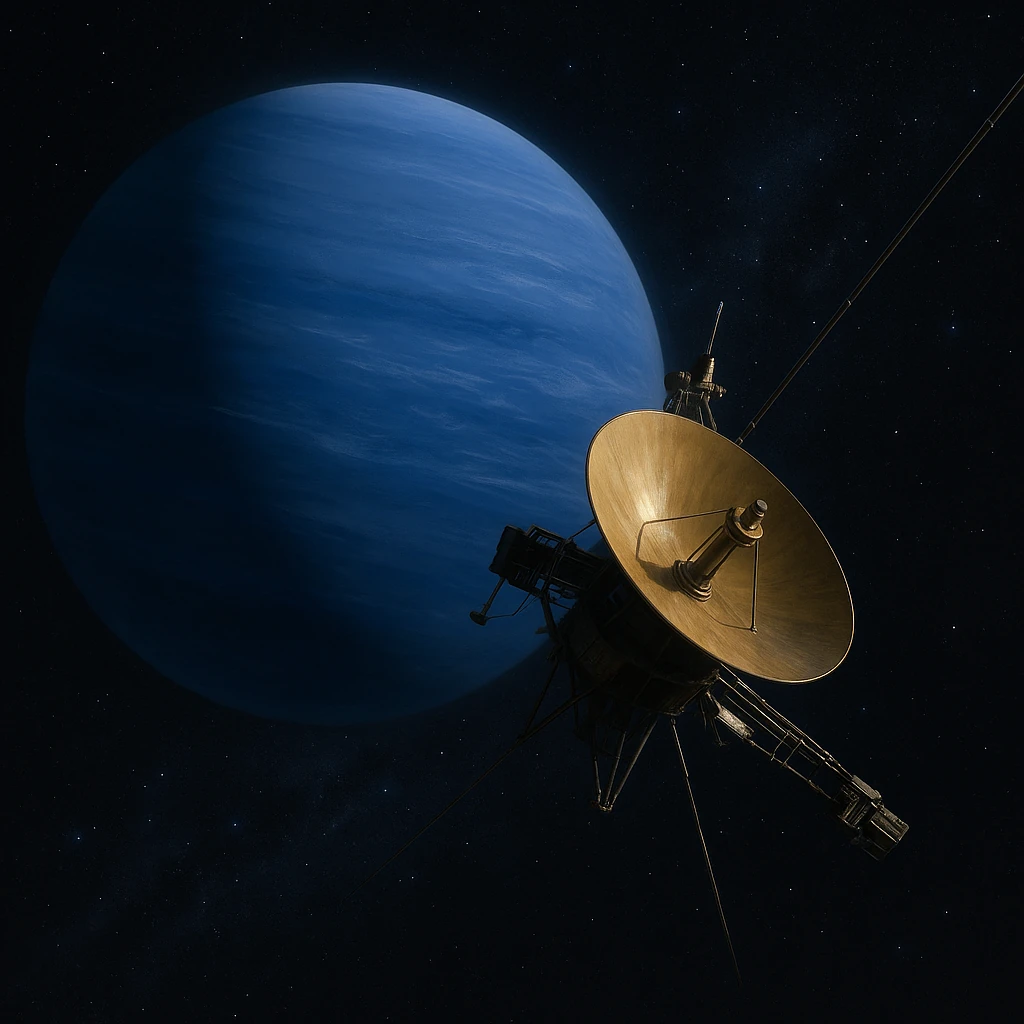
Neptune has been visited only once by a spacecraft, a rare feat given its distance. Specifically, Voyager 2, launched by NASA in 1977, flew by Neptune on August 25, 1989, after a 12-year journey. For example, the probe captured images of the Great Dark Spot and high-speed winds in Neptune’s atmosphere. Additionally, it photographed Triton, revealing its geysers and icy surface with “cantaloupe terrain.” Voyager 2, moreover, measured Neptune’s magnetic field, finding it 27 times stronger than Earth’s at the surface. However, no other missions have reached Neptune since, due to the immense distance and cost. By 2025, the James Webb Space Telescope has studied Neptune using infrared light. It, for instance, detected subtle changes in its cloud structures and thermal emissions. As a result, new insights into Neptune’s atmosphere and rings emerged, enhancing our understanding. Future missions, like a proposed Neptune orbiter in the 2030s, may reveal more. Thus, each discovery about Neptune deepens our knowledge of this distant world.
Leave a Reply