Introduction
The atomic bomb, a weapon of unprecedented power, reshaped warfare and global politics in the 20th century. Atomic bomb development marked a turning point in scientific history, driven by breakthroughs in nuclear physics and wartime urgency. Who created atomic bomb technology that changed the world? Scientists like Albert Einstein and J. Robert Oppenheimer played pivotal roles, leading to the Manhattan Project atomic bomb. This article explores the journey of atomic bomb development, from early theories to the complex technology of uranium enrichment bomb production, the Manhattan Project’s role, and the deployment in Hiroshima. As of April 2025, understanding this process reveals both the ingenuity and the ethical dilemmas of harnessing nuclear energy for destruction.

Early Concepts and Theories
The roots of atomic bomb development trace back to early 20th-century physics. In 1905, Albert Einstein’s theory of relativity (E=mc²) established that mass could be converted into energy, laying the theoretical foundation. In 1938, German physicists Otto Hahn and Fritz Strassmann discovered nuclear fission, splitting uranium atoms to release immense energy. This breakthrough sparked global interest. Who invented the atomic bomb concept? While no single person “invented” it, Hungarian physicist Leo Szilard proposed a chain reaction in 1939, realizing its potential for a weapon.
Szilard and Einstein, alarmed by Nazi Germany’s advancements, wrote to President Roosevelt in 1939, urging the U.S. to pursue atomic bomb development. Their letter catalyzed early research, though the technology was still theoretical. Scientists understood that a uranium enrichment bomb required isotopes like uranium-235, which could sustain a chain reaction. By 1940, researchers at Columbia University confirmed the feasibility of atomic bomb technology, setting the stage for a massive wartime effort. These early concepts, driven by theoretical physics, were crucial for the practical steps that followed.

The Manhattan Project
The Manhattan Project, launched in 1942, was the cornerstone of atomic bomb development. Who created atomic bomb designs under this secretive program? J. Robert Oppenheimer, often called the “father of the atomic bomb,” led the effort at Los Alamos, New Mexico. The project, costing $2 billion (equivalent to $30 billion today), involved over 130,000 people across multiple sites. Its goal was to build a functional uranium enrichment bomb before the Axis powers.
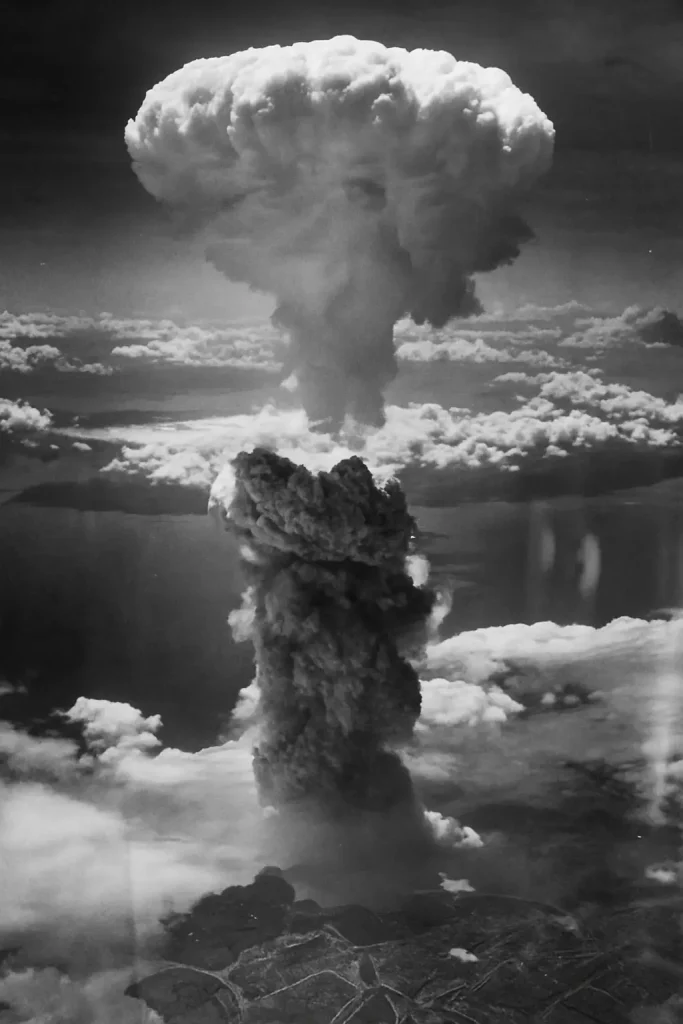
Key sites included Oak Ridge, Tennessee, for uranium enrichment, and Hanford, Washington, for plutonium production. The Manhattan Project atomic bomb required two designs: “Little Boy” (uranium-based) and “Fat Man” (plutonium-based). Scientists faced challenges, such as separating uranium-235 from uranium-238, which they achieved through gaseous diffusion and electromagnetic separation. By 1945, the project succeeded, culminating in the Trinity test on July 16, 1945—the first nuclear explosion. The Manhattan Project atomic bomb demonstrated the feasibility of atomic bomb technology, but its success came with profound ethical questions about its use.
Technology and Production
Atomic bomb development hinged on mastering complex technologies. A uranium enrichment bomb, like Little Boy, required 64 kg of uranium-235, enriched to 90% purity. Oak Ridge’s Y-12 plant used electromagnetic separation, a process consuming 10% of U.S. electricity in 1944. Plutonium production, for Fat Man, involved reactors at Hanford that irradiated uranium to create plutonium-239. Both methods demanded precision, as impurities could halt chain reactions.
Atomic bomb technology also required delivery systems. The bombs weighed 4-5 tons, necessitating modified B-29 bombers. The implosion design for Fat Man, using explosives to compress plutonium, was a breakthrough, tested successfully at Trinity. Who invented the atomic bomb’s implosion mechanism? Physicist Seth Neddermeyer proposed it, refining atomic bomb development. By 1945, production scaled to deliver two bombs, showcasing the industrial might behind the Manhattan Project atomic bomb. These technological feats, while groundbreaking, raised concerns about proliferation and safety, issues still debated in 2025.
Deployment and Immediate Impact
The culmination of atomic bomb development was its deployment in 1945. On August 6, Little Boy was dropped on Hiroshima, releasing energy equivalent to 15 kilotons of TNT. Three days later, Fat Man struck Nagasaki. Who was the inventor of the atomic bomb used in Hiroshima? While Oppenheimer oversaw the project, the design stemmed from collaborative efforts at Los Alamos. Hiroshima’s devastation was immediate—70,000 died instantly, with tens of thousands more from radiation by year’s end.
The bombings forced Japan’s surrender on August 15, 1945, ending World War II. However, the human cost sparked global debate. Atomic bomb technology, while a military success, introduced long-term challenges like radiation sickness and nuclear arms races. In Hiroshima, rebuilding efforts continue, with memorials like the Peace Dome standing as reminders. The Manhattan Project atomic bomb not only reshaped warfare but also set the stage for modern nuclear policy, influencing treaties like the 1968 Non-Proliferation Treaty.

Leave a Reply