Introduction
The Big Bang theory explains the universe’s origin 13.8 billion years ago. It describes a hot, dense state expanding into today’s cosmos, supported by redshift and cosmic microwave background (CMB). For example, the CMB’s 2.7 K radiation confirms early conditions. This article examines the theory’s origins, evidence, technological advancements, and theoretical developments. Unresolved issues, like dark matter, remain. The Big Bang theory anchors modern cosmology. Observational data highlight its role.
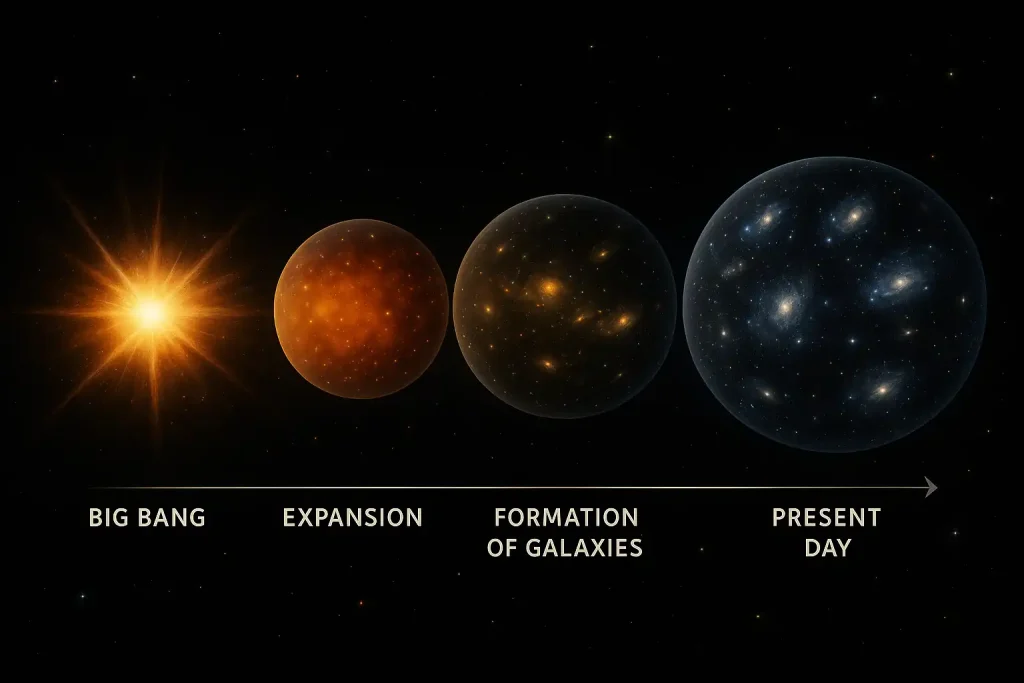
This framework unifies physics and astronomy to trace cosmic evolution. From a singular point, space, time, and matter emerged, forming galaxies. Technological and theoretical advances refined the model. Historical evidence, therefore, underscores its explanatory power. This analysis explores its milestones and challenges. The history of this cosmic model shapes our understanding.
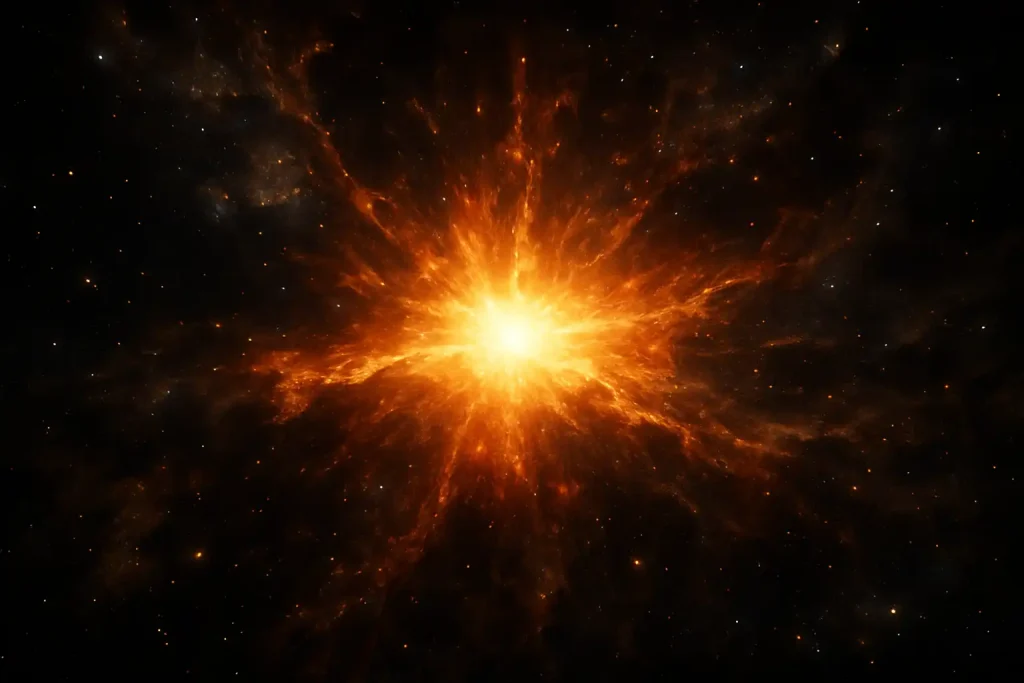
Conceptual Origins of the Big Bang Theory
The origins of the Big Bang theory trace to early 20th-century cosmology. Before 1900, static universe models assumed an eternal cosmos. Einstein’s 1915 general relativity suggested a dynamic universe, allowing expansion or contraction. For example, his equations challenged static assumptions. Early theorists debated cosmic origins. The Big Bang theory emerged from these discussions. Relativity provided its mathematical basis.
In 1927, Georges Lemaître proposed an expanding universe from a “primeval atom.” His hypothesis, based on galactic redshift, suggested a singular origin. By 1929, Edwin Hubble’s observations confirmed expansion, undermining static models. Lemaître’s ideas, initially overlooked, sparked debate. The origins of the Big Bang theory faced resistance. For instance, steady-state proponents suggested continuous matter creation. Lemaître’s work laid a foundation for cosmology.
The term “Big Bang” was coined in 1949 by Fred Hoyle, a steady-state advocate, as a critique. Hoyle’s radio broadcasts popularized the phrase, despite his skepticism. By the 1950s, competing models drove research. This framework gained traction with new evidence. Its conceptual roots reflect paradigm shifts. Early debates shaped its development. The model evolved through rigorous testing.
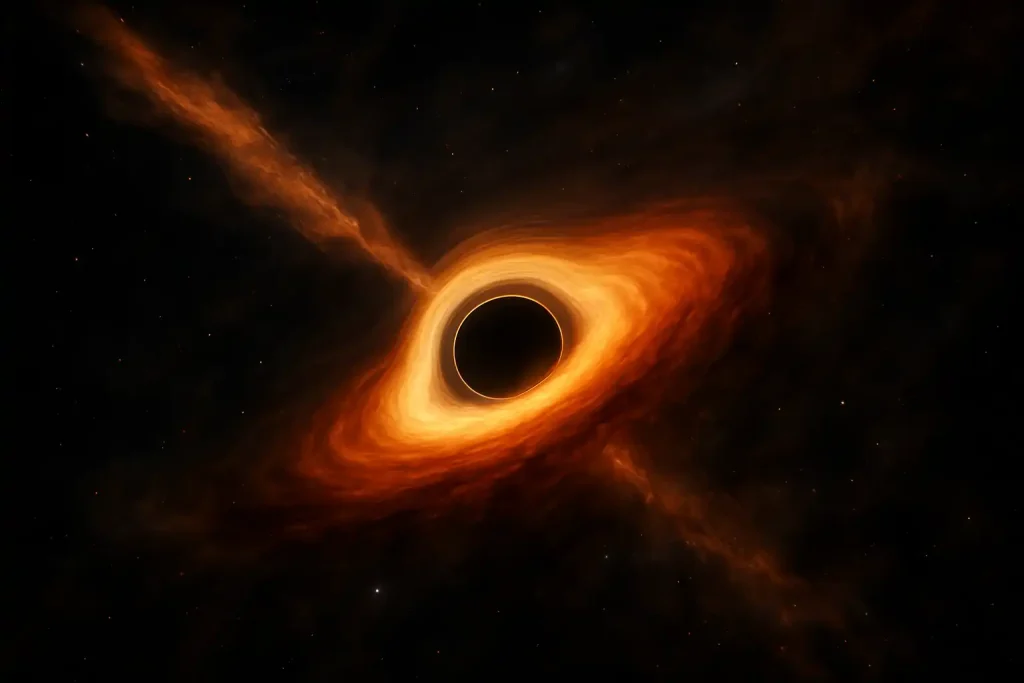
Evidential Foundations
The Big Bang theory rests on robust observations. In 1929, Edwin Hubble measured galactic redshift, showing galaxies recede faster with distance. This confirmed cosmic expansion, a key prediction. For example, Hubble’s law linked velocity to distance. This cosmic model aligns with these findings. Observations supported Lemaître’s hypothesis. Redshift remains a cornerstone.
In 1965, Arno Penzias and Robert Wilson discovered the CMB, radiation from the early universe. Detected at 2.7 K, this radiation matches predictions of a hot, dense origin. Bell Labs’ radio antenna captured the signal accidentally. For instance, its uniformity supports isotropic expansion. The Big Bang theory strengthened with this evidence. The CMB sidelined steady-state models. Its discovery was pivotal.
Big Bang nucleosynthesis explains light element abundances. Within minutes of the cosmic origin, hydrogen and helium formed, matching observed ratios (75% hydrogen, 24% helium). Calculations predict trace lithium and deuterium, confirmed by stellar spectra. For example, these ratios align with a 13.8 billion-year-old universe. Chemical signatures bolster the framework. Nucleosynthesis supports the timeline. Observations continue to validate it.
Technological Advancements in Cosmology
Technological advances refined the cosmic model. Optical telescopes, like Hubble’s Mount Wilson in the 1920s, measured galactic distances, enabling redshift studies. By the 1990s, the Hubble Space Telescope mapped distant galaxies precisely. For example, its deep-space images revealed early galaxy formation. These tools confirmed cosmic expansion. Advancements in cosmology drove breakthroughs. Telescopes remain critical for testing predictions.
Radio telescopes detected key evidence. The 1965 CMB discovery used Bell Labs’ Holmdel antenna, sensitive to microwave frequencies. The 1989 COBE satellite mapped CMB fluctuations, revealing density variations. For instance, these variations explain galaxy clustering. Radio technology validated early universe predictions. Its precision enhanced cosmological models. Such advancements shaped modern cosmology.
Particle accelerators probed early universe conditions. CERN’s Large Hadron Collider, operational since 2008, recreates high-energy states, studying quark-gluon plasmas. These experiments simulate post-origin temperatures, testing the Big Bang theory. For example, they confirm early particle interactions. Accelerators bridge cosmology and physics. However, high costs limit access. These tools inform the framework.
Computational models improved cosmic simulations. Since the 1990s, supercomputers have modeled evolution, incorporating dark energy and matter. The 2013 Planck satellite’s data refined these models, estimating the universe’s age at 13.8 billion years. For instance, simulations predict CMB patterns accurately. Computing enhances theoretical precision. Yet, dark matter’s nature eludes detection. The framework benefits from these advances.
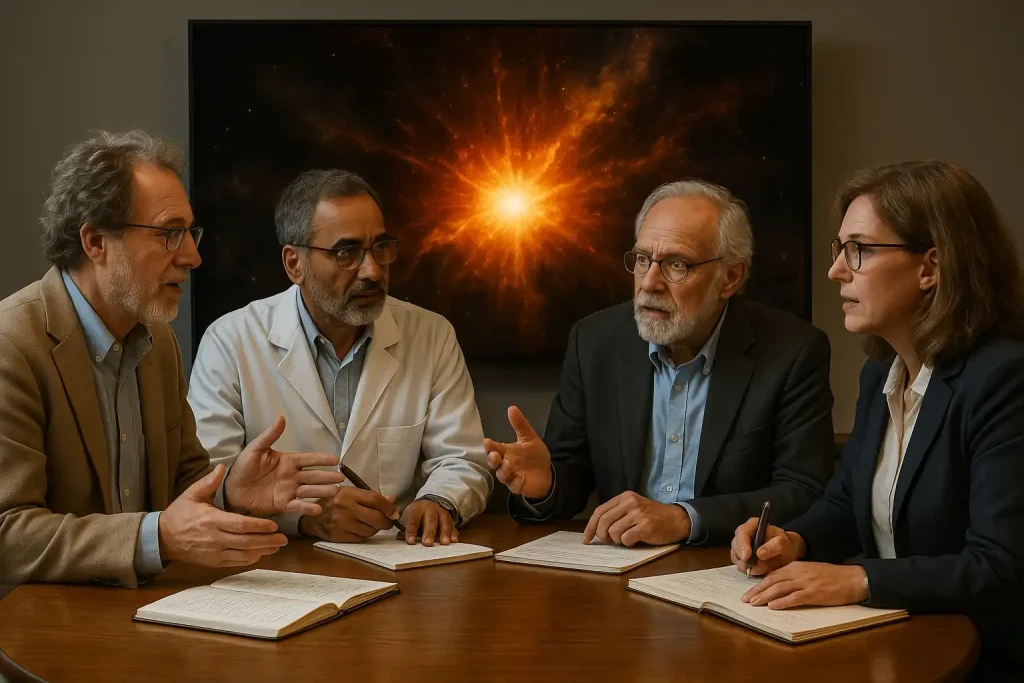
Theoretical Developments
The Big Bang theory expanded with new models. In 1980, Alan Guth proposed cosmic inflation, a rapid expansion 10⁻³⁶ seconds after the origin. Inflation explains the universe’s flatness and uniformity. For example, it accounts for CMB’s isotropic patterns. This model resolves early inconsistencies. The framework incorporates inflation. Its predictions align with observations.
Dark energy, identified in 1998, drives accelerated expansion. Supernova observations showed galaxies receding faster than expected, suggesting a repulsive force. Dark energy, comprising 68% of cosmic energy, shapes the universe’s fate. For instance, it predicts eventual cooling. The cosmic model adapted to include dark energy. Its discovery reshaped cosmology. Accelerated expansion remains a focus.
Dark matter, roughly 27% of cosmic mass, influences gravity without emitting light. Detected via galactic rotation curves, it stabilizes galaxy formation. The model predicts dark matter’s role in early structure formation. For example, its presence affects CMB fluctuations. Dark matter’s composition remains unknown. Theoretical developments highlight this gap. Experiments aim to identify it.
The pre-Big Bang state raises philosophical and scientific questions. Current models do not explain conditions before the singularity. Philosophically, it challenges causality and time’s origin. Quantum cosmology, like Hartle-Hawking’s no-boundary model, suggests a finite universe without a start, while loop quantum gravity proposes a prior bounce. For instance, multiverse models remain untestable. These theories fuel debate. Cosmology evolves with such inquiries.
Leave a Reply