Introduction
The question of how water arrived on our planet is a cornerstone of planetary science. Often called the “Blue Planet,” Earth holds about 1.386 billion cubic kilometers of water, a resource vital for life. Scientists have explored various theories, from cosmic impacts to volcanic releases, to explain this abundance. The origin of Earth’s water is key to understanding not just our planet’s past but also the potential for life elsewhere in the universe. For instance, water influences climate, shapes geological features, and supports biological diversity across ecosystems. This article examines the hypotheses and modern research that seek to unravel this enduring mystery.
Water’s presence is essential, yet its journey to Earth billions of years ago remains unclear. Early ideas pointed to comets or asteroids delivering ice during the planet’s formative years. More recent studies suggest internal processes, like volcanic activity, played a significant role in creating early oceans. Moreover, analyzing isotopic data and geological evidence helps trace the path of this vital resource from the solar system’s birth to today’s rivers and seas. Let us start with the initial theories that sparked this scientific quest.
However, finding a definitive answer is fraught with difficulties. Conflicting data from space missions and lab analyses often challenge proposed models. Some theories lack solid evidence due to technological limits of the past, while others evolve with new findings. In addition, the quest to understand the origin of Earth’s water blends ancient clues with cutting-edge discoveries. This complexity fuels ongoing research into our planet’s history.

Early Hypotheses
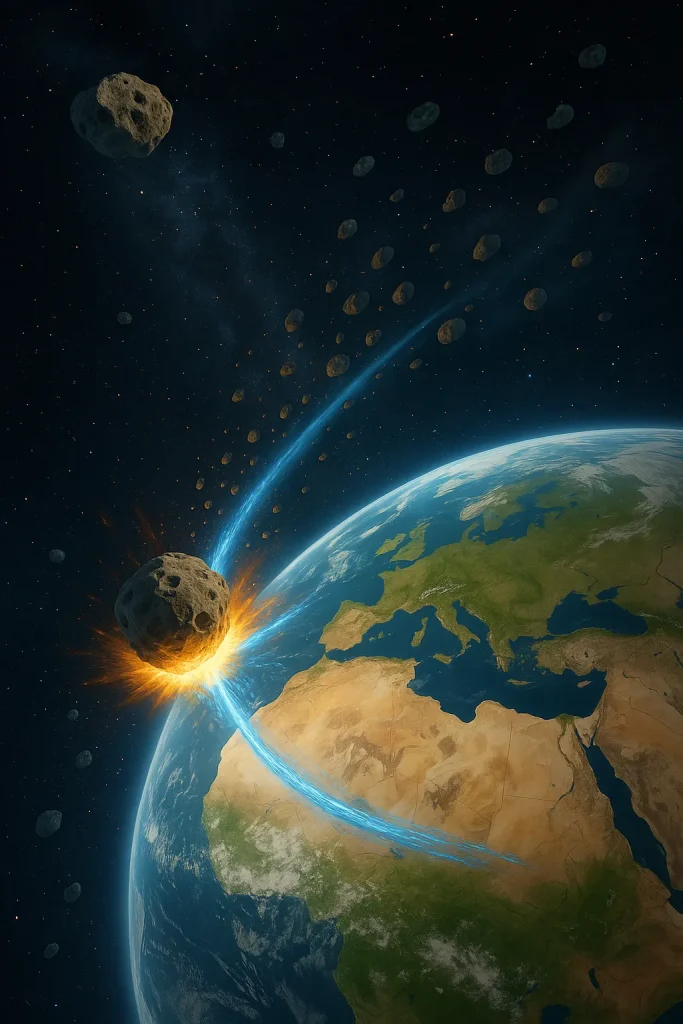
In the 18th and 19th centuries, scientists first proposed that comets brought water to Earth. During the Late Heavy Bombardment, around 4.1 to 3.8 billion years ago, these icy bodies from the outer solar system may have crashed into the young planet. Astronomers like those studying Halley’s Comet saw it as a potential carrier, igniting early debates about its role in shaping Earth’s surface. This idea suggested that water vapor or ice from these impacts contributed to the planet’s early hydrology. These early thoughts laid a foundation for later research, though they relied heavily on observation rather than proof.
Another theory suggested asteroids from the asteroid belt as a source of water. Carbonaceous chondrites, meteorites rich in hydrated minerals, were thought to have delivered water during Earth’s formation. Researchers noted that these bodies, formed closer to the sun, might match the isotopic makeup of Earth’s oceans. For example, analysis of meteorite samples fueled this hypothesis, though the total water volume remained uncertain. The origin of Earth’s water became a battleground between comet and asteroid theories in early scientific circles.
However, these ideas faced significant hurdles due to limited tools. Without precise isotopic analysis, conclusions were often speculative, based on planetary motion models. Some questioned whether cometary water aligned with Earth’s deuterium levels, casting doubt on that theory. On the other hand, the asteroid model struggled to explain the vast ocean volumes. Thus, while influential, these early hypotheses on the origin of Earth’s water set the stage for more detailed studies.
Cometary and Asteroidal Contributions
Modern research has revisited comets as a potential water source. NASA’s Stardust mission in 2006 analyzed comet Wild 2, finding water ice, but its deuterium-to-hydrogen ratio differed from Earth’s oceans. This suggested comets might contribute only about 10% of the planet’s water, a smaller role than once thought. The Rosetta mission’s data on Comet 67P further supported this, showing varied compositions among comets. However, some scientists argue that certain comets could still have played a part, given the diversity in the solar system.
Asteroids, especially carbonaceous chondrites, offer a stronger case for water delivery. Studies of meteorites like the Murchison sample reveal hydrated minerals that release water when heated. Estimates indicate these bodies may have supplied 30-50% of Earth’s water during its accretion, around 4.54 billion years ago. Moreover, isotopic similarities between these meteorites and ocean water bolster this theory, though the retention of water during impacts remains a topic of debate. This evidence positions asteroids as a key player in the planet’s water story.
Yet, challenges persist in confirming these contributions. The intense heat of impacts might have vaporized much of the water, reducing what stayed on Earth. Some suggest cometary data might reflect sampling bias from specific comets studied. On the other hand, asteroid delivery timing and scale are hard to pinpoint. Thus, while cometary and asteroidal inputs shape our understanding, they form only part of the puzzle.

Volcanic Outgassing Theory
The volcanic outgassing theory suggests an internal source for water on Earth. As the planet cooled from its molten state, gases trapped in the mantle, including water vapor, were released through volcanic eruptions. This process likely peaked during the Hadean Eon, contributing to the formation of early oceans over millions of years. For example, geological estimates suggest this could account for 20-30% of the planet’s current water volume. This internal mechanism offers a compelling alternative to external delivery models.
The theory hinges on hydrated minerals within Earth’s mantle. These minerals, incorporated during the planet’s formation, released water when heated by volcanic activity. Research on ocean floor basalts shows isotopic signatures that align with mantle-derived water, supporting this idea. Moreover, volcanic outgassing likely created a steam atmosphere that condensed into liquid as the planet cooled, complementing theories of cosmic water input. This dual approach enriches the narrative of how water arrived.
However, critics question whether outgassing alone could fill the oceans. The high temperatures of early eruptions might have expelled water into space before it could accumulate. Some argue that mantle water reserves might be underestimated, based on recent studies. On the other hand, the theory’s reliance on internal processes adds depth to the discussion. Thus, volcanic outgassing remains a vital piece in explaining the origin of Earth’s water.
Modern Scientific Insights
Advances in technology, like mass spectrometry, have refined our view of water’s arrival. Scientists compare deuterium-to-hydrogen ratios in Earth’s water with samples from space, such as lunar rocks and Martian meteorites. A 2020 Nature Geoscience study found water in Earth’s mantle, suggesting an early internal supply that challenges outer solar system origins. For instance, this evidence shifts focus toward a combined source model for the planet’s hydrology. These tools provide a clearer picture of water’s journey.
Modern models blend cometary, asteroidal, and volcanic contributions. Simulations indicate Earth accreted water-rich material during formation, with asteroids playing a major role alongside outgassing. The protoplanetary disk’s water content supports this integrated perspective, refined by missions like Japan’s Hayabusa2 on asteroid Ryugu. Moreover, isotopic analysis of ocean water continues to align with these diverse sources. This holistic approach advances our understanding of the planet’s past.
However, uncertainties linger despite these advances. The exact proportion of each source is elusive due to gaps in early Earth data. Some debate whether the Moon-forming impact lost water to space, complicating the timeline. On the other hand, ongoing research into ocean isotopes offers hope for resolution. Thus, modern science continues to deepen our grasp of the origin of Earth’s water.
Leave a Reply