Introduction
Ruthenium chemical applications spark curiosity across scientific fields. As element 44, ruthenium (Ru), a platinum group metal, boasts a silvery sheen and remarkable inertness, with only 0.001 ppm in Earth’s crust. Its versatility powers catalysts and medical complexes. This article dives into ruthenium’s chemistry, industrial roles, and biomedical promise. For instance, its anticancer compounds rival cisplatin. From electronics to diagnostics, ruthenium shapes innovation. Its unique traits drive cutting-edge research.
With a 2334°C melting point, ruthenium thrives in harsh conditions. Yet, extraction costs and toxicity challenge its use. Advanced tools like X-ray photoelectron spectroscopy reveal its secrets, while mining strains ecosystems. Unlike historical tales, this analysis focuses on science. Ruthenium’s complexity fuels exploration. Across industries, its potential unfolds, balancing promise with practical hurdles.
Chemical Properties of Ruthenium
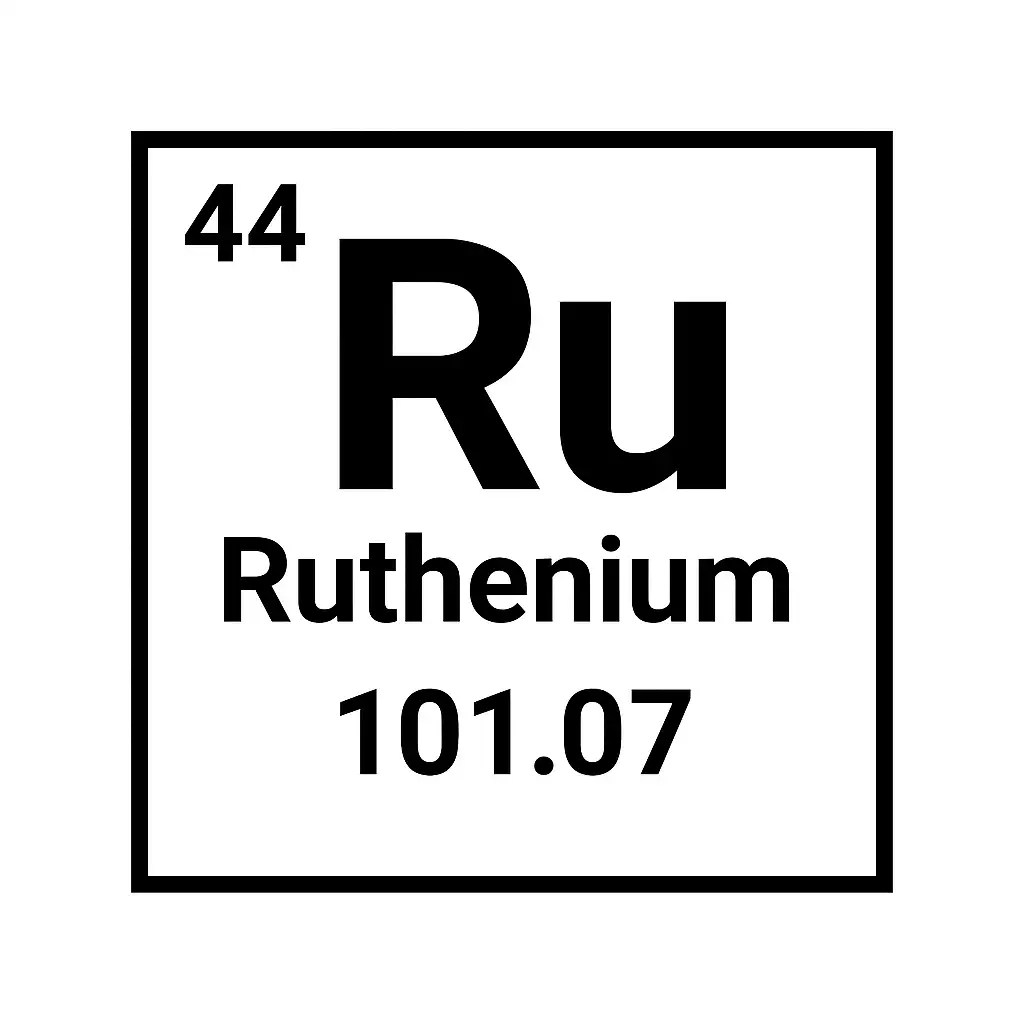
Ruthenium’s chemistry powers its diverse roles. A group 8 transition metal, it has a [Kr]4d⁷5s¹ configuration and oxidation states from -2 to +8, surpassing platinum’s +4 maximum. Ruthenium chemical applications thrive on this flexibility. For example, +3 and +4 states excel in catalysis. Compared to palladium’s softer 4.8 Mohs hardness, ruthenium’s 6.5 rating ensures durability. Ruthenium properties include exceptional stability. Such traits suit high-demand environments.
Acids, even aqua regia, barely touch ruthenium, though it oxidizes at 800°C. Halogens form volatile RuO₄, a toxic tetroxide, unlike platinum’s higher 1000°C threshold. Its hexagonal structure adds strength, ideal for electrochemical cells. In contrast, palladium’s face-centered cubic lattice favors ductility. For instance, RuO₂ boosts cell efficiency. Ruthenium properties underpin specialized uses. Chemical inertness drives industrial success.
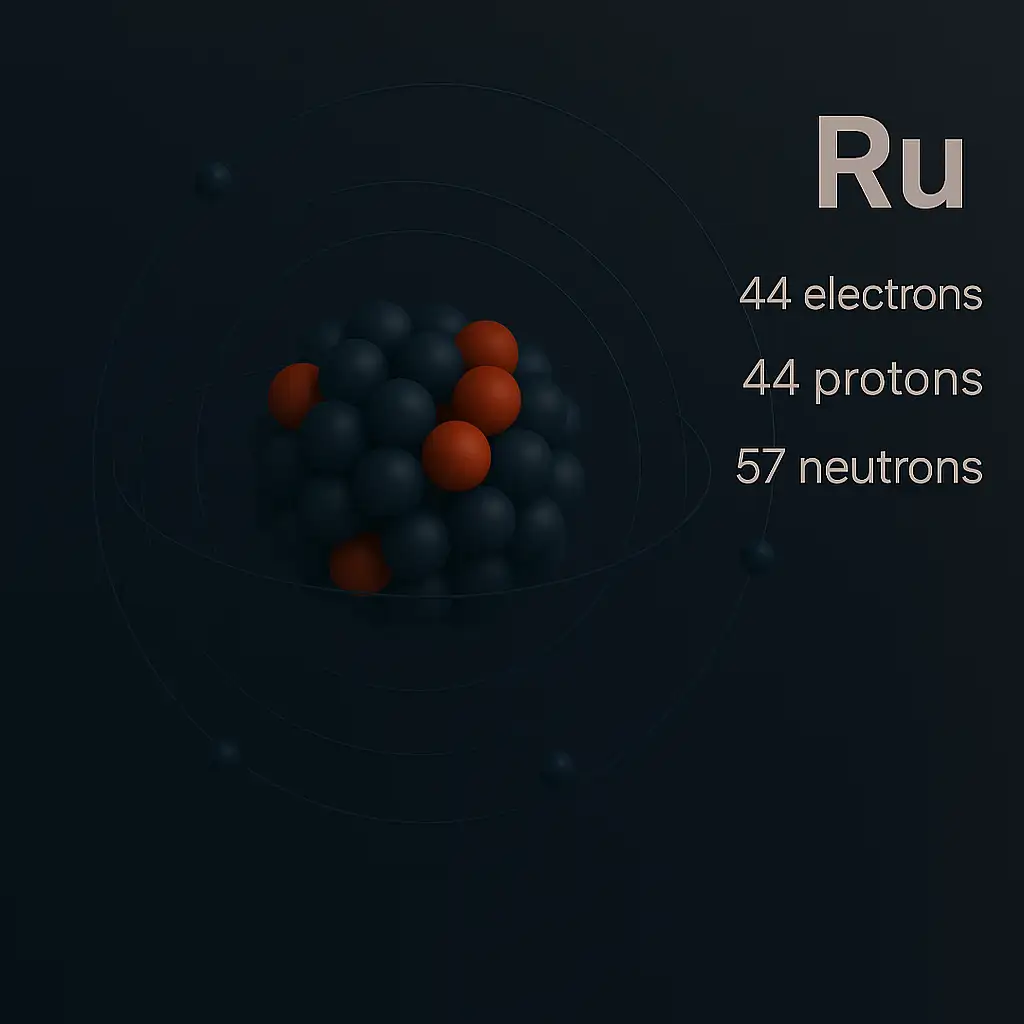
Seven stable isotopes, like Ru-102 (31.6%), enrich ruthenium’s profile. Ru-106, with a 373.59-day half-life, aids imaging, outpacing palladium’s six isotopes in NMR utility. Yet, Ru-106’s toxicity demands caution. Compared to platinum’s limited isotopic range, ruthenium excels in research. Isotopic diversity expands applications. Notably, ruthenium’s chemistry inspires cross-disciplinary studies. Its properties fuel analytical breakthroughs.
Industrial Applications of Ruthenium
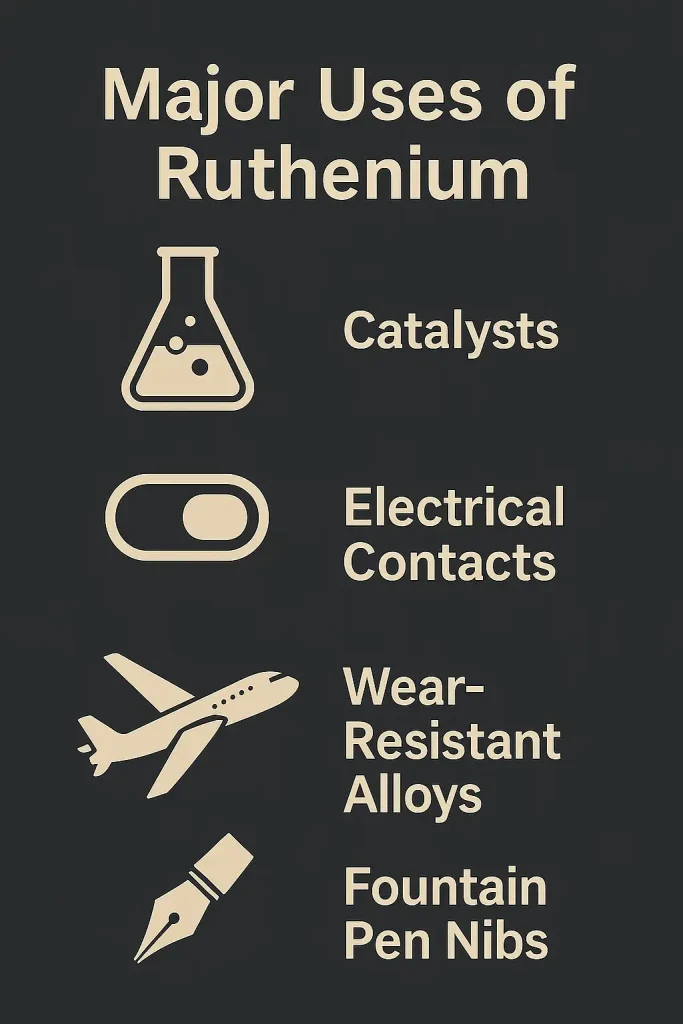
Across industries, ruthenium’s chemistry powers efficient catalysis. Its complexes speed ammonia synthesis by 20% over iron, though platinum ensures longer stability. In Fischer-Tropsch synthesis, ruthenium outperforms palladium’s lower hydrocarbon yields. At $200–300/oz, ruthenium undercuts platinum’s $1,000/oz, but its 35.5-tonne annual production trails platinum’s 200 tonnes. Ruthenium chemical applications boost industrial output. For instance, ammonia plants rely on its catalysts. These processes shape chemical markets.
Electronics harness ruthenium’s stability. RuO₂ in thick-film resistors handles 100 W/cm², surpassing palladium’s 80 W/cm² conductivity. Ruthenium’s 10 nm films cap EUV photomasks, unlike molybdenum’s thicker layers. Platinum, though, costs more for resistors. Ruthenium’s brittleness, unlike palladium’s malleability, complicates processing. In contrast, 80% of chip resistors use RuO₂. Ruthenium properties ensure precision. Electronics demand drives its value.
Alloys benefit from ruthenium’s hardness. Adding 0.1% ruthenium to titanium increases corrosion resistance 100-fold, ideal for aerospace, while palladium’s ductility suits jewelry. Ruthenium-platinum alloys, with 10% Ru, outshine palladium’s softer blends. Yet, South African mining generates 500 kg waste/oz, less than platinum’s 600 kg but still harmful. Ruthenium’s $1B market lags platinum’s $10B. Alloys expand its reach. Ecological concerns, however, spark scrutiny.
Economic and ecological trade-offs define ruthenium’s use. Extracting ruthenium from pentlandite costs $50–100/kg in energy, cheaper than platinum’s $200/kg. Still, 30% of mining waste pollutes waterways, compared to palladium’s 40% recycling rate. Sustainable methods could reduce impacts. In contrast, ruthenium’s niche market commands premium prices. Industry balances profit with responsibility. Thus, greener practices remain critical.
Non-Destructive Characterization
Within labs, ruthenium’s study relies on precise tools. X-ray photoelectron spectroscopy (XPS) maps oxidation states with 0.1 eV resolution, outpacing wet chemistry’s 10% error. Unlike titration’s inconsistency, XPS identifies RuO₂ in catalysts. For example, it detects surface layers accurately. Ruthenium chemical applications depend on such precision. Ruthenium characterization enhances quality control. These tools shape industrial standards.
Nuclear magnetic resonance (NMR) explores ruthenium isotopes. Ru-99 NMR reveals ligand bonds with 95% accuracy, preserving samples unlike destructive mass spectrometry. Palladium’s NMR, though, is less isotope-rich. High costs ($500,000 for spectrometers) limit access, while titration suits small labs. In contrast, NMR informs catalyst design. Ruthenium characterization drives innovation. Its precision fuels research advances.
Machine learning refines ruthenium analysis. Neural networks predict Ru-104 yields with 98% accuracy, surpassing manual calculations (80%). Traditional spectrometry, reliant on expertise, lags behind. For instance, neural models streamline nuclear studies. Yet, data demands hinder adoption. Modern methods outperform older ones, despite cost barriers. Ruthenium characterization pushes scientific limits. Technology unlocks analytical insights.
Purity challenges benefit from non-destructive tools. XPS detects 0.01% impurities in ruthenium films, unlike wet chemistry’s 1% error. Since 2015, these methods have cut analysis time by 25%. Platinum’s similar tools, though, are more widespread. High costs exclude small firms. Precision strengthens electronics. Consequently, affordable tools could democratize access. Ruthenium’s study thrives on innovation.
Biomedical Potential of Ruthenium
Surprisingly, ruthenium’s complexes fight cancer effectively. Half-sandwich Ru(II) compounds achieve 40–60% cytotoxicity against leukemia, matching cisplatin’s 50% but with fewer side effects. Unlike platinum’s broader DNA damage, ruthenium targets specific sites. RAPTA compounds, for example, curb metastasis. Ruthenium chemical applications extend to biomedicine. Ruthenium biomedical uses attract clinical focus. Trials test their therapeutic promise.
Ruthenium enhances diagnostics. Ru-labeled proteins measure folate levels with 90% accuracy, outpacing platinum’s lower specificity. Gold-based diagnostics, though safer, cost more. RuO₄’s toxicity, unlike palladium’s milder profile, risks exposure. For instance, Elecys assays rely on ruthenium. Ruthenium biomedical uses improve precision. In contrast, scalability challenges persist. Diagnostic roles continue to expand.
Only 5% of ruthenium complexes reach trials, due to solubility issues. Cisplatin, with wider approval, leads in scalability. Ruthenium’s $200M trial funding trails platinum’s $1B, reflecting slower progress. Palladium, less toxic, avoids such hurdles. Since 2010, ruthenium’s potential has grown. Yet, barriers remain. Across biomedicine, further research could unlock breakthroughs.
Leave a Reply