Introduction
String Theory stands as one of the most ambitious frameworks in modern physics, aiming to unify the fundamental forces of nature. It proposes that the basic building blocks of the universe are not particles but tiny, vibrating strings. These strings, far smaller than atoms, vibrate at different frequencies to create particles like electrons and quarks. For example, this framework seeks to bridge the gap between Einstein’s general relativity, which governs gravity, and quantum mechanics, which describes the other three forces: electromagnetic, strong, and weak. Physicists estimate these strings to be about 10^-35 meters long, a scale known as the Planck length. Developed over decades, this concept has evolved into a leading candidate for a “theory of everything.” As of 2025, researchers continue to explore its implications through advanced mathematics and experimental hints. This article delves into the core concepts, history, applications, and challenges of String Theory. Let’s unravel the mysteries of this fascinating idea.
Core Concepts of Vibrating Strings
At the heart of this theory lies the idea that the universe operates on a deeper level than particles. Instead, one-dimensional strings vibrate at specific frequencies, and these vibrations determine the properties of particles. For instance, a string vibrating in one mode might manifest as an electron, while another mode could produce a photon. String Theory requires the universe to have more than the familiar four dimensions—three of space and one of time. Most versions propose 10 or 11 dimensions, with the extra dimensions “compactified” into tiny, curled-up shapes at scales too small to detect. Additionally, the framework includes two types of strings: open strings, with endpoints, and closed strings, which form loops. Closed strings are particularly significant because they can produce gravitons, the hypothetical particles that mediate gravity. A key aspect of this theory is supersymmetry, a principle suggesting that every particle has a “superpartner” with different spin properties. This symmetry helps address inconsistencies in quantum gravity. Therefore, String Theory offers a radically different view of the universe’s fundamental structure.
A Historical Journey of String Theory
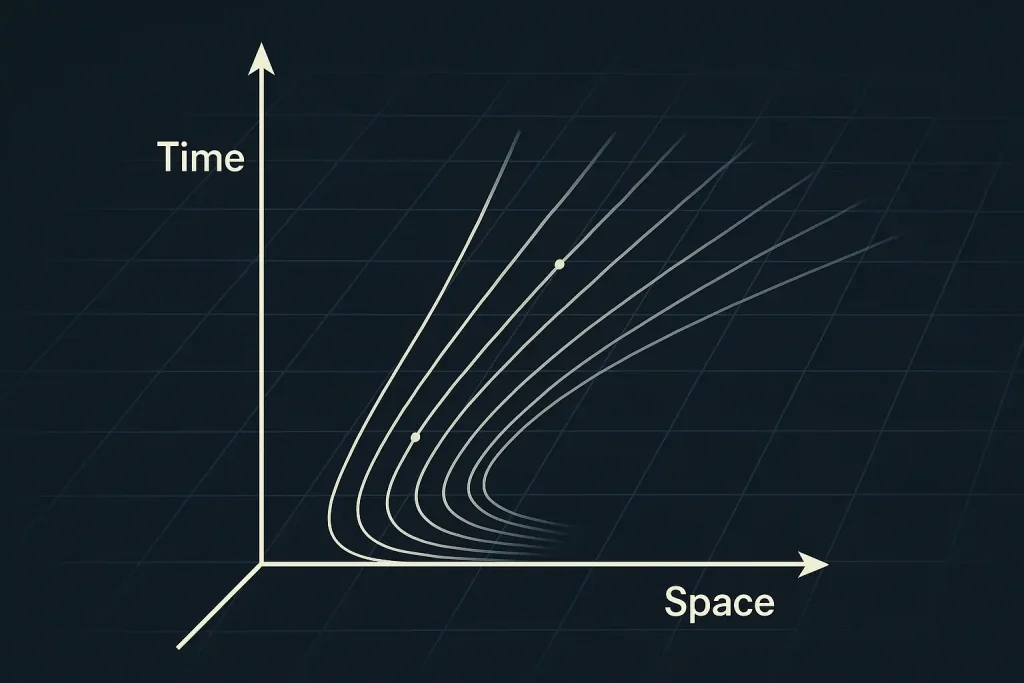
The origins of String Theory trace back to the late 1960s, when physicists were grappling with the strong nuclear force. In 1968, Gabriele Veneziano proposed a mathematical model to describe particle interactions, which later became the foundation of this framework. By 1970, researchers like Yoichiro Nambu and Leonard Susskind realized that Veneziano’s model described vibrating strings rather than point-like particles. Initially, this idea faced skepticism because it predicted a particle, the tachyon, that traveled faster than light—a theoretical impossibility. However, in 1974, John Schwarz and Joel Scherk discovered that the theory naturally included gravitons, making it a potential candidate for quantum gravity. The 1980s marked the “First Superstring Revolution,” when physicists developed five consistent versions of the theory, all requiring 10 dimensions. For example, the Type I, Type IIA, and Type IIB theories emerged during this period. In 1995, Edward Witten led the “Second Superstring Revolution” by introducing M-Theory, which unified the five versions into an 11-dimensional framework. As of 2025, this concept remains a theoretical construct, with ongoing efforts to find experimental evidence. Its history reflects a remarkable journey of mathematical innovation.

Applications in Physics and Beyond
This framework has far-reaching implications, even if it remains unproven. One of its primary goals is to reconcile general relativity and quantum mechanics, offering a unified description of all forces. For instance, by incorporating gravity through gravitons, String Theory addresses a major limitation of the Standard Model of particle physics, which excludes gravity. Additionally, it has inspired breakthroughs in mathematics, particularly in the field of geometry. The concept of extra dimensions led to the development of Calabi-Yau manifolds, complex shapes that describe how extra dimensions might be compactified. In cosmology, this theory provides potential explanations for the early universe, such as the rapid expansion during the Big Bang, through models like the “string gas cosmology.” Moreover, it has influenced black hole physics. A 2023 study in Physical Review Letters used string-based models to explain the entropy of black holes, aligning with predictions from quantum mechanics. Beyond physics, the framework has even impacted fields like condensed matter physics, where string-like behaviors model certain material properties. Therefore, its applications extend across multiple disciplines, despite its theoretical nature.
Challenges Facing String Theory Today
Despite its promise, String Theory faces significant hurdles that researchers continue to tackle as of 2025. One major challenge is the lack of direct experimental evidence. Since strings are far too small to observe with current technology, physicists rely on indirect tests, such as searching for supersymmetric particles at facilities like the Large Hadron Collider (LHC). However, no such particles have been detected yet, raising doubts about supersymmetry. Another issue is the framework’s complexity. It predicts 10^500 possible universes, known as the “string landscape,” making it difficult to pinpoint our universe’s specific configuration. For example, this vast number of possibilities complicates predictions about physical constants, like the strength of gravity. Additionally, the requirement of extra dimensions poses a problem—while mathematically consistent, these dimensions remain undetected. Critics argue that the theory may be untestable, labeling it more philosophy than science. A 2024 paper in Nature Physics highlighted ongoing debates about its falsifiability. Moreover, competing theories, like loop quantum gravity, offer alternative paths to quantum gravity without extra dimensions. Therefore, these challenges underscore the need for innovative approaches to validate String Theory’s claims.
Leave a Reply