Introduction
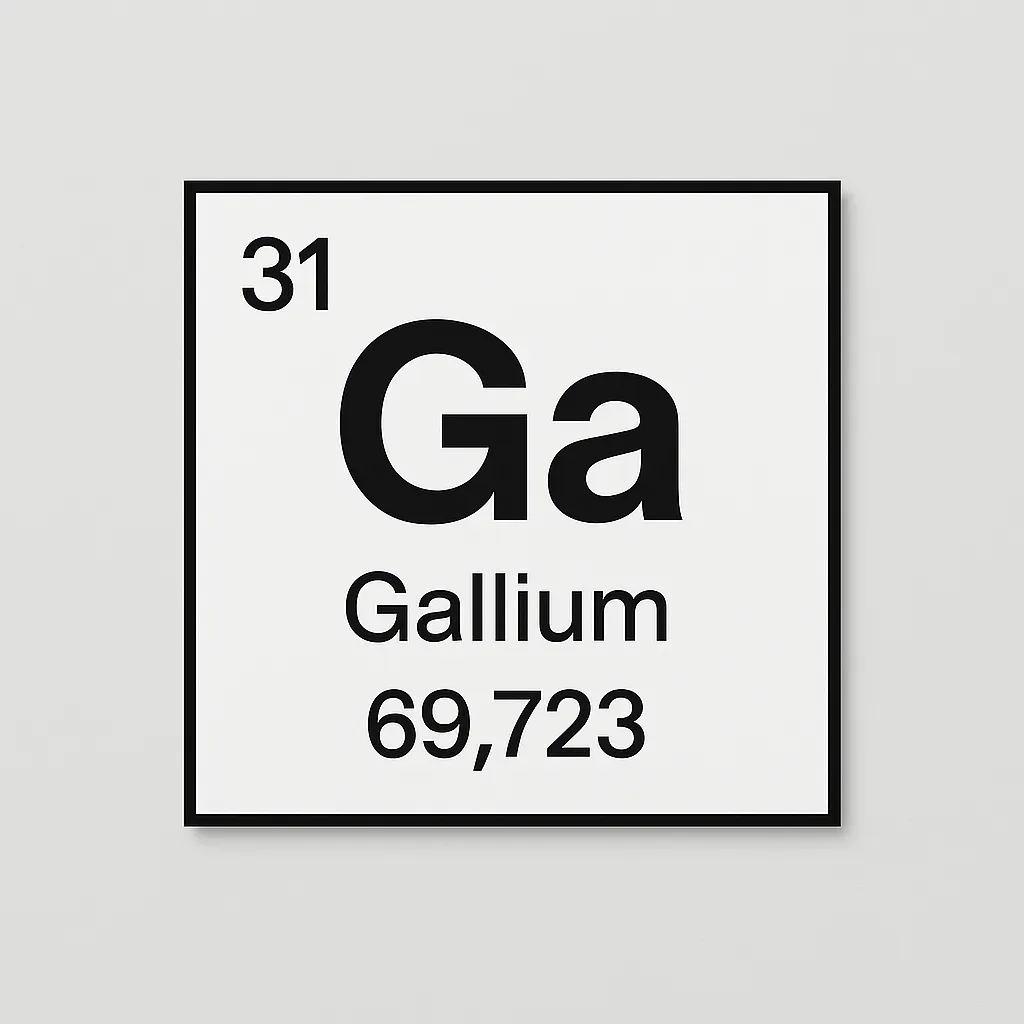
The gallium element 31 intrigues scientists with its unusual properties and versatile applications. Positioned in group 13 of the periodic table, this soft, silvery metal boasts atomic number 31 and an atomic weight of 69.723 u. Discovered late in the 19th century, it melts at just 29.76°C (85.57°F), close to room temperature, making it a standout metal. Its rarity and unique traits fuel its value in modern technology. This article dives into its discovery, properties, and role in industry and health.
Gallium gained attention due to its unexpected behavior. Unlike most metals, it expands when it solidifies, a trait shared with water and a few others. Scientists prize it for its semiconductor properties, powering electronics globally. Moreover, its discovery fulfilled Dmitri Mendeleev’s prediction of “eka-aluminum”—a hypothetical element he foresaw based on periodic trends—adding credibility to the periodic table. This metal’s journey from obscurity to essential resource highlights its scientific significance.
Despite its promise, gallium faces accessibility challenges. It does not occur freely in nature and requires extraction from ores like bauxite. Its limited supply and rising demand raise sustainability concerns. Researchers continue to explore its potential, driving interest in this unique metal across various fields.
Discovery and Natural Occurrence
French chemist Paul-Émile Lecoq de Boisbaudran discovered the gallium element 31 in 1875 using spectroscopy—a technique that identifies elements by their unique light patterns, or “spectral lines.” He detected these patterns in a zinc blende sample, naming it after his homeland, Gaul (France), and possibly hinting at his name, “Lecoq.” Mendeleev had predicted this element as “eka-aluminum”—a placeholder for an element below aluminum—years earlier, and its properties matched his forecast. This discovery validated the periodic table’s predictive power.
Gallium occurs naturally in trace amounts, primarily in bauxite and sphalerite ores. Miners extract it as a byproduct of aluminum and zinc production, yielding about 100 tons annually worldwide. Its abundance in the Earth’s crust is low, around 19 parts per million, making it scarcer than gold. Interestingly, seawater and coal contain minute traces, though extracting it from these sources remains uneconomical. This rarity shapes its market dynamics.
In contrast, gallium’s distribution varies globally. China dominates production, supplying over 90% of the world’s supply, followed by Russia and Ukraine. Geopolitical factors and mining limitations affect its availability. Scientists seek alternative sources, like recycling from electronics. This element thus reflects both geological and economic complexities.
Physical and Chemical Properties
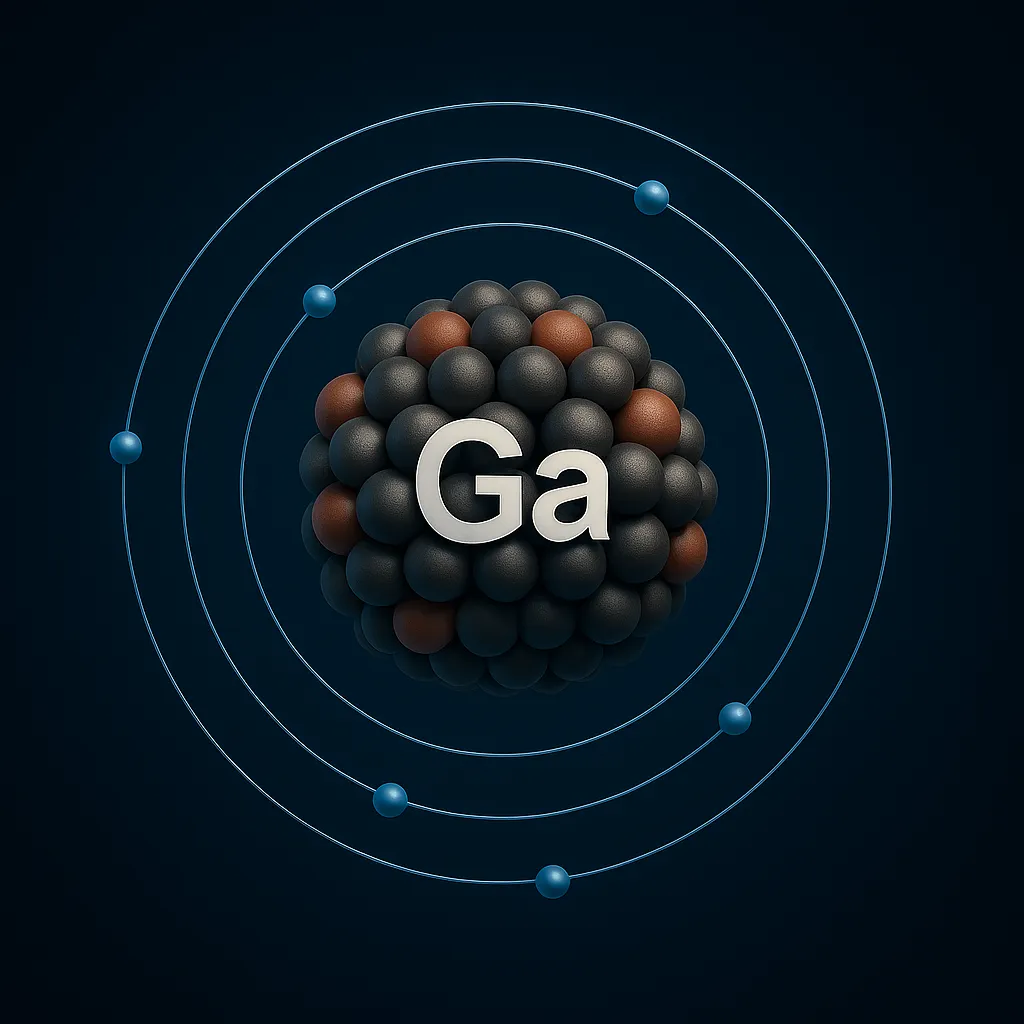
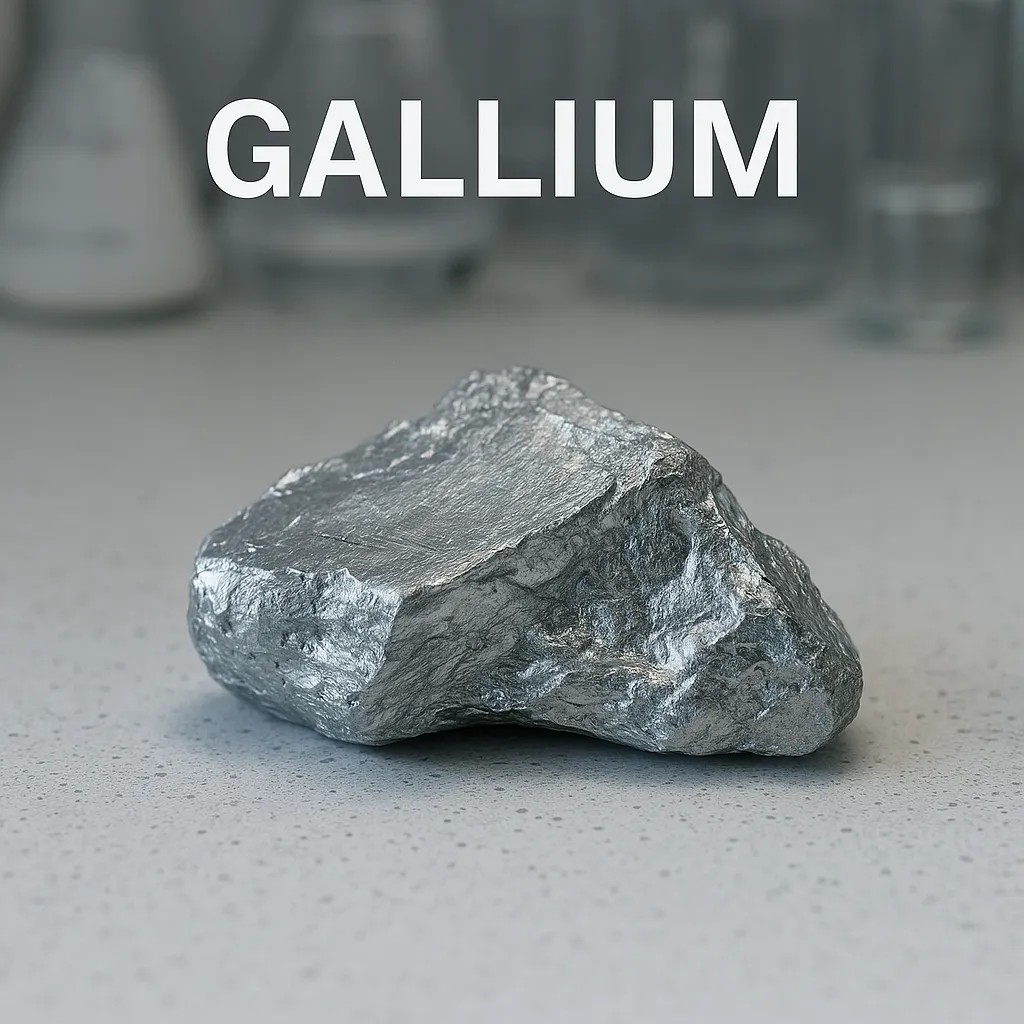
The gallium element 31 exhibits unique physical traits that set it apart. It melts at 29.76°C (85.57°F), turning liquid in a warm hand, yet boils at 2,403°C (4,357°F), showing a wide liquid range. Its density increases from 5.91 g/cm³ (liquid) to 6.095 g/cm³ (solid), an anomaly causing expansion upon solidification. This metal shines with a silvery appearance but tarnishes slowly in air. Its softness lets it be cut with a knife, unlike harder metals.
Chemically, the gallium element 31 acts as a post-transition metal with moderate reactivity. It resists corrosion, forming a protective oxide layer when exposed to air or water. Gallium reacts with acids and alkalis, producing hydrogen gas, but resists oxidation at high temperatures. Its compounds, like gallium arsenide, serve as semiconductors due to a bandgap of 1.43 eV, a key gallium property. Moreover, it alloys with most metals, enhancing its utility.
Interestingly, these properties pose challenges. Its low melting point complicates storage, requiring it to stay below 30°C in solid form. Exposure to other metals can cause embrittlement in alloys. On the other hand, its non-toxic nature and stability make it safe for many uses. This element continues to fascinate with its blend of quirks and strengths.
Industrial Applications
Industries rely on the gallium element 31 for cutting-edge technologies. Gallium arsenide and gallium nitride power semiconductors in LEDs, lasers, and solar cells, outperforming silicon with higher efficiency and faster switching. In LEDs, these compounds emit bright colors—red, green, and blue—used in displays and lighting, with global LED production reaching 150 billion units in 2023. Gallium also enhances fiber-optic cables and 5G devices, driving a 10% annual demand increase.
Manufacturers blend gallium with indium and tin to create liquid metal alloys for medical imaging and 3D printing. In imaging, gallium-68 powers PET scans, detecting cancer with 90% accuracy by targeting tumors, a process that has saved countless lives since the 1990s. The aerospace sector uses gallium in radar systems and satellite components, a key gallium use, valuing its lightweight properties. Moreover, its role in quantum computing research promises future breakthroughs.
Nevertheless, supply constraints challenge its applications. China’s dominance in production creates risks of shortages or price spikes. Recycling from old electronics offers a partial solution, though it remains underdeveloped. Scientists explore synthetic alternatives to reduce reliance. This element thus plays a pivotal role in shaping modern industry.
Health and Environmental Impact
The gallium element 31 poses minimal health risks, earning a reputation as non-toxic. Workers handle it safely in labs and factories, as it does not accumulate in the body like heavy metals. Medical uses include gallium-67 and gallium-68 isotopes for cancer diagnostics, with gallium-68 PET scans offering detailed tumor images, improving treatment plans. However, inhaling gallium dust or fumes may irritate the lungs, requiring proper ventilation.
Environmentally, gallium has a low impact due to its scarcity and controlled use. Mining bauxite for aluminum releases gallium as a byproduct, but this process generates minimal waste compared to other metals. Recycling electronics reduces environmental strain, though landfilling e-waste can release trace amounts into soil. Interestingly, its stability prevents it from polluting water sources significantly.
In contrast, over-reliance on this metal raises concerns. Depletion of high-grade ores and energy-intensive extraction could harm ecosystems. Some advocate for stricter recycling laws to manage waste. On the other hand, its medical benefits outweigh risks when handled properly. The gallium element 31 balances innovation with environmental responsibility.
Leave a Reply